

Time to engage in a little bit of wishful speculation. We know most or all of the aircraft line-up for 1CGS’ Korean War 1950-1953 simulation that has finally been formally announced. But the title has the potential to offer even more aircraft to the mix than the initial offering and add a variety of different roles too. So for this speculative article I wanted to explore some of the potential offerings that 1CGS may decide to do after the initial launch.
Developing content after launch
Most games and sims these days tend to launch with an initial offering and then use DLC packages to extend the game and provide a steady stream of content post launch. That’s just how things go these days and so with that in mind there are plenty of aircraft that aren’t being covered by the initial launch collection of 8 aircraft. Some of these may emerge and become announced as premium aircraft types before launch and some may be part of individual sales or some sort of collection sale later on too.
On the western side
Rushed into battle, UN backed American and western forces moved a mix of WWII era and more modern aircraft into battle over the Korean peninsula. Everyone knows the jet duels of the F-86 Sabre and MiG-15 over Korea, however, these two aircraft were just some of an interesting mix of airplanes.
AD Skyraider

Used from land bases as well as aircraft carriers, the first aircraft on the list is the AD Skyraider (it would take on the A-1 designation in the 1960s). This long lived aircraft was developed during WWII but saw its combat debut in the Korean War. Intended as an attack aircraft, this role is already a popular experience in the IL-2 series and so if its not ultimately one of the aircraft in the base package, I can see it coming in the immediate aftermath as a counter to the IL-10.
F-82 Twin Mustang

Why have one Mustang when you can bolt a second fuselage onto the first for even more range and even better altitude performance? Six M3 .50cal machine guns, 25 5in rockets, 4 1000lb bombs or long range fuel tanks could be carried by this slightly unusual machine. The F-82 was intended as a long range escort fighter and did see some use in the role, however, the appearance of the MiG-15 made the type obsolete. It was instead used to cover Seoul and nearby Allied airbases from attack and used in some ground attack operations. These were withdrawn by 1952.
F-94 Starfire

Derived from the T-33 Shooting Star (itself derived from the F-80), these all weather interceptors had a radar system in the nose and either 24 or 48 Mk 4/Mk 40 Folding-Fin Aerial Rockets instead of the usual guns. The type took over the F-82s interception duties over Seoul and was credited with the first night time jet-vs-jet combat victory.
B-26 Invader

Post war re-designation schemes for the USAF make for a bit of confusing reading and writing when we talk about the B-26. There’s the WWII era B-26 Marauder, withdrawn from service by the time of the Korean War, and there’s the A-26 Invader which stayed on as bomber and attack aircraft and was re-designated B-26. These aircraft were active during the first couple of years of the war flying various attacks including the first airfield attack near Pyongyang.
C-47, C-54 or C-119

While I know not everyone is thrilled by flying transport aircraft in a combat simulator, it has increasingly been a source of fun and joy for myself flying C-47s, Ju52s and Li-2s in IL-2 Great Battles on various logistical operations. There’s no way that I couldn’t include at least one transport aircraft on the list.
The C-47 needs little introduction as this DC-3 derived military transport was still in use during the Korean War. There’s also Douglas’ C-54 Skymaster of which one was destroyed on the ground at Kimpo airbase during the war.
We also have the C-119 Flying Boxcar which may be the best option when it comes to its operational history. The aircraft was used to drop paratroopers during the war as well as large cargo packages. In one operation they were even used to drop portable bridge sections to support ground troops and engineers.
Meteor F.8
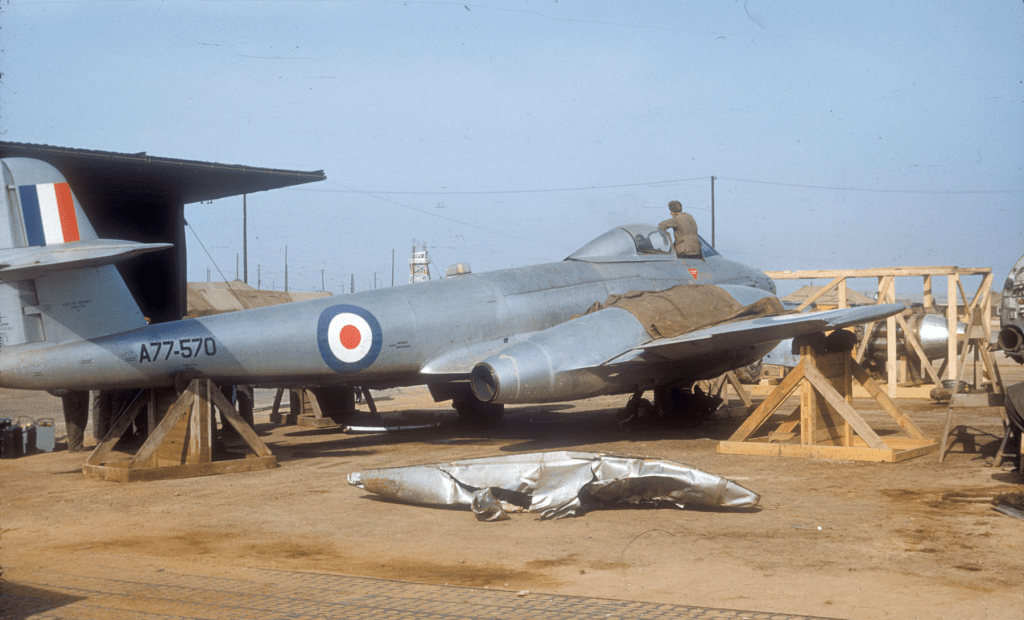
The definitive variant of the Meteor, the F.8, was used by Commonwealth forces in Korea. Notably used by the RAAF. It was used first as a fighter. Then when it became clear the MiG-15 was superior, the type was moved to ground support missions where the Meteor flew thousands of missions.
Sea Fury
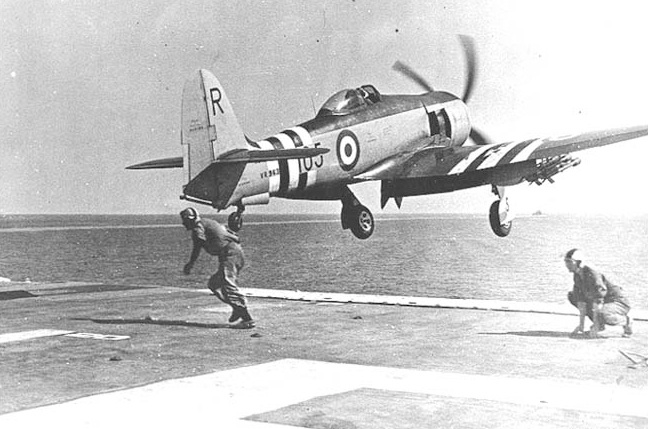
A development of the Typhoon and Tempest, the Fury and Sea Fury were intended to be lightened aircraft with higher performance than their predecessor fighters. With WWII wrapped up and excessive inventory of fighters already on hand, the RAF dropped their interest in the type but the Royal Navy needed a replacement for their not entirely well suited to carrier operations Seafire. The Sea Fury served for several years with the Royal Navy and with some commonwealth countries including Australia. Both Royal Navy and Royal Australian Navy carriers were equipped with the aircraft when they joined the fighting over Korea. The Sea Fury was used for ground attack primarily though it did do battle with MiG-15s and was credited with one of the only piston engine jet kills in the war (though there is some dispute on the account).
F9F Panther
This one might already be in going by some interface icons that we’ve seen. Without it being confirmed, I thought I’d throw it into the list too.

We might hopefully see carrier operations developed post launch, the F9F Panther was flown from both land and carrier bases during the war as the US Navy and US Marine Corps primary fighter and fighter-bomber. Four 20mm cannon, an extensive array of air to ground weapons, and a reputation for being durable, the F9F took credit for the first US Navy victory of the war (against a Yak-9) and was involved in a famous 35 minute air battle that saw Lt Royce Williams of VF-781 and his wingman engage in an air battle of Soviet MiG-15s. His F9F returning with hundreds of holes in the airplane.
HH-19

This last one is a bit of a fun concept because for the IL-2 series it’d be something entirely new. A helicopter! Helicopters were starting to enter service during WWII but it was Korea where several models began to enter the conflict in important ways. The HH-19 was used by all US services an was used for search and rescue, supply and troop insertion, and more.
On the eastern side
La-11
Developed from the La-9 which itself owes quite a bit to the La-7 and 5 before it, the La-11 (NATO reporting name “Fang”) was used primarily by the Chinese PLAAF during the Korean War. One infamous battle involved the La-11, used as an escort fighter for Tu-2 bombers, facing off against F-86 Sabres. Though the Sabre’s scored a number of kills against the bombers and escorting fighters, an La-11 did manage to bring down a Sabre (the first piston engine kill for the PLAAF against a jet) and damage a couple of other Sabres before the engagement was over.
U-2
The infamous U-2 is already an aircraft that we have in the IL-2 Great Battles series and you may be thinking that a slow biplane has no business being involved in the Korean War. However, the aircraft were used against UN troops during the battle and some were intercepted by attacking jets and high performance propeller aircraft that struggled to get a shot on the extremely slow moving biplane.
Tu-2
Already confirmed to be in the sim, the Tu-2 bomber was used on multiple air operations during the Korean War. It’s not a flyable type (so far as we know) so I’d love to see it make the flyable roster at some point.
Anything else to add to the list?
This is just a fun exploration of the types of aircraft and missions that IL-2 Korea might be able to explore depending on how much scale and scope the team ultimately pursue with the project. Anything I missed? Let me know in the comments!


 Stormbirds
Leave a comment