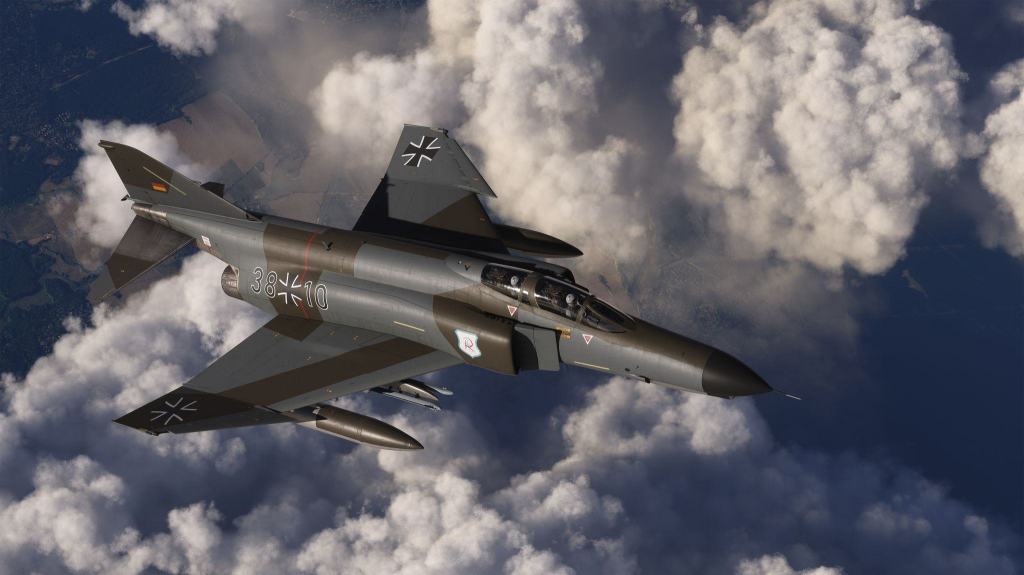
Now that Heatblur’s long awaited DCS: F-4E Phantom is out and everyone is flying it there are a few issues that are being revealed and here are some of the items that I’ve heard about and what some of the plans are for fixing them. Let’s have a look!

Radar performance and other issues

A module as complex at the Phantom is bound to have a few issues and though Heatblur have a great reputation for delivering quality modules, its not unusual through the intensive testing of putting thousands of people on a module that some issues are going to shake out. And a few have.

An update several days ago from Heatblur addressed some early issues:

– VR UI Cut-off: for this, please ensure that you check the “Use DCS Resolution” checkbox in your DCS misc. settings. This will hopefully correct this issue. A more robust handling of this for all internal and external VR resolutions for this will hopefully be developed soonest.

– Strange Pitch Control Issues: If you’re not using a Force Feedback stick, please ensure the force feedback setting is off in your game options. Unfortunately, some non-FFB sticks report being FFB capable to DCS, causing this issue. For better realism, the F-4 controls behave differently depending on whether you have force feedback or not, but this can cause an aggressive pitching movement if you are not using an FFB stick.

Heatblur on Facebook

These aren’t the only that have cropped up either. Many users are reporting severe framerate drops in some specific circumstances surrounding the use of the radar on the F-4E. Fortunately, its a known issue too and Heatblur are working on a fix for that too.

We’re hotfixing a few issues in the radar that cause a massive drop in very very busy scenarios, as found on ECW. Hopefully a hotfix will be available soon.

Cobra847 on the DCS forums

There are undoubtedly some other items that have cropped up but the radar one has, in particular, been registered by users. Scenarios with large numbers of targets online seem to be the place where the issue crops up the most.

Hopefully we’ll see the hotfix coming up soon!


12 responses to “Fixes are coming for DCS: F-4E’s radar performance and other bugs”

  1. I’ve had good performance with the Phantom. Though the cockpit graphics sometimes are slow to load, but that could be my fault because of y rig or my settings.

    Like

    1. ShamrockOneFive Avatar
      ShamrockOneFive

      They can be slow to load everywhere I think. DCS is very texture heavy so it can take a bit to stream them in.

      The radar issue is very situational from what I’ve read. The module performs very well for me in the situations I’ve put it into.

      Like

  2. Last night I watched Requiem go through engine start ground ops, some max performance turns, some landings and air refueling. The AOA indexer lights and aural tone are currently PORKED. The indexer lights in the sim only illuminate when the gear is down. That is wrong, they work continuously. The aural tone for 19 units AOA is the a steady tone. That coincides when the AOA gauge needle is at the white mark at the 3 o’clock position. In game while maneuvering the aural tone lags much worse than RL.

    For some reason he was unable to check the adverse yaw effect since he couldn’t get the LES locked IN. FWIW, Requiem was pretty damn good on the boom for his first try.

    Liked by 2 people

    1. ShamrockOneFive Avatar
      ShamrockOneFive

      Some interesting details that they haven’t gotten quite right yet. Always interesting!

      I was just talking with Req about his relatively easy experience linking up with a tanker… that’s something I haven’t done yet but I had a terrible time trying to keep the F-16 in the right profile. Curious to see how the F-4 goes!

      Like

      1. The AOA issue should be fixed. It’s not terribly significant when you’re dropping bombs, but it is when you’re maneuvering hard versus a SAM or another jet. It’s just a fundamental part of the USAF F-4 experience.

        Regarding refueling in the F-4 compared to the F-16. IRL when you open the IFR door on the F-16, it’s like you added a smoothing response curve to your joystick. It makes the F-16 much easier to refuel compared to the F-4. With the F-4 you could feel the CG shift aft as you took on fuel, and as I alluded to in a previous post, you could reach a point where both throttles at Full Military thrust was insufficient to stay on the boom. That’s when you would get creative and pull one back as you put the other into Min Burner hoping you didn’t get a hard light off.

        Liked by 2 people

      2. ShamrockOneFive Avatar
        ShamrockOneFive

        Definitely! Hopefully something that can be sorted out soon.

        I was remembering your post and then reading about some other accounts where you had one engine just into afterburner to keep things going with a full loadout. Must try sometime in the sim too! 🙂

        Like

    2. AOA tones gear up are not, as you so quaintly put it, “PORKED”. See my comment below; TL:DR they work just like the jet.

      In the current release the high-AOA adverse yaw characteristics are undermodelled, this is a known issue that is being worked on. Easy test (from a warning in the dash-1) is to lock the slats in and pull over 25 units; the book says the jet should immediately depart; the current release does not. Patience, grasshopper…

      Locking the slats in works fine, but is awkward without binding to HOTAS or buttons, and requires opening the cover then moving a toggle switch – and the controls are located way back on the left sidewall where they are hard to see. Not a big deal IMO because unless you have a slat problem (assymetrical extension, chattering, etc) you never really have to use that switch; although some people liked to lock the slats when refuelling to prevent them from cycling when on the boom (which could happen at certain weights, speeds, and altitudes).

      Vulture

      Liked by 1 person

    3. Nicholas Dackard Avatar
      Nicholas Dackard

      Hi!

      This is actually not correct. 🙂 The AoA indexer lights logic changed with the introduction of slats and wiring diagrams show it correct as is. This is a common point of confusion and our SMEs remarked on it as well, but we double and triple checked.

      Liked by 1 person

  3. The AOA indexers on the F-4E are off when the gear is up. This is correct per the dash-1 and my personal experience in the jet. Gear up they are used for AGM-45 steering.

    Also, in the slatted jet HB has modelled, with the gear up the AOA tones are shifted up so the steady tone is at 23.5 to 24.5 units (not 19.2 for landing, gear down). This is due to the higher AOA capabilities of the slatted jets, where subsonic maximum performance turns are at around 25 units (this is a quote from the dash-1).

    All this is correctly simulated in the HB F-4E.

    Vulture

    Liked by 1 person

    1. If you say so, this is my source for the error. I wonder when the correction was made.

      From the 1 February 1979 1F-4E-1, page 1-30 under description of Angle of Attack Indexers.


      The AOA indexers (figure 1-8), which operate from switches in the AOA indicator, are on each side of the windshield above the front cockpit instrument panel and above the rear cockpit instrument panel. The indexers provide continuous AOA visual indication of optimum airplane flight conditions by illuminating symbolic cutouts…[snip description]. In most cases the indexer lights display AOA information continuously during flight. The two exceptions are: When an AGM-45 is installed and selected with the landing gear retracted and when the AN/ASQ-91 is operated in the sefl-test mode. For AOA indexer lights functions during AGM-45 operation, refer to TO 1F-4E-34-1-1. Refer to section VI for additional information.

      My bad on the AOA aural tone with gear up and slats out. Steady aural tone at 23-25 units. I don’t have this DCS module, so I’ll let you have the floor.

      Cheers

      Like

    2. Just some additional thoughts, cuz this is an excellent time to bring up how procedures and in this case AOA indexer function change over time.

      Can you type what your Dash 1 says about AOA Indexer function to show the significant change that can take place? I had a late 80s Dash 1 but tossed it two years ago.

      I mention this because up until the summer of 1982 IIRC (when the guys from Seymour Johnson deployed to Germany) the Dash 1 airspeed to fly when single engine was 250 KIAS. One the guys had a flameout behind the tanker, long story short the tanker drifted down to ~2k’ above the waves with them and drug them to KEF at 250 KIAS (in the region of reverse command at altitude). The accident board discovered the Dash 1 was grossly in error and the recommended SEng airspeed was bumped up to ~280 KIAS. They would have made KEF sooner and at a much higher altitude. I remember briefing this at a squadron safety meeting. In my last career I flew with the wingman (Jeff Shields).

      Liked by 1 person

  4. Sorry, my response is lost somehow. Bottom line is that the later Es changed how the AOA indexers worked. Cs (which I trained in) and Ds worked as you describe, basically.

    Vulture

    Like

Leave a reply to Kirk Stant Cancel reply

Trending