

I was surprised by the announcement that Eagle Dynamics are planning the development of an F-35A for DCS World. I’ve been reflecting on what this development means for the sim and have finally decided to put thoughts to key presses and write this editorial. We’re going to cover some ground here so buckle up!
Identity crisis
The most surprising thing about the F-35 for DCS World is that Eagle Dynamics intend to make this one of their “full fidelity” modules. We can talk more about what full fidelity means in a bit but let’s just take that in the broader context for now in terms of what DCS World’s identity is and how this might fit into that identity that the developers and community have shaped together.
DCS World for the longest time has been heralded as the sim that has pushed the boundaries for realism. The sim that was more unforgiving than the others, that had fewer helpers, and that emphasized deep understanding of aircraft systems for players and an even deeper understanding required for developers to bring us these aircraft. This all before a module was even remotely considered for the role. This had to mean that we had to be happy with older iterations of airplanes – even our most advanced options in the sim are a decade or two out of date.
It has become something of a refrain in the community by both the developers and echoed by us, the fans, that some aircraft were just not possible because of insufficient documentation. That has been used by Eagle Dynamics and by third party developers committed to offering high detail experiences to us – the demanding and discerning flight simmer.
But I think the bigger shock when you think about it is not that we feel like the DCS: F-35 is going to rely on some guesswork but perhaps the recognition that maybe this isn’t the only time this has happened.
Some things that we know over the years have been adjusted significantly include RAZBAM’s Mirage 2000C. This was clearly held up as high fidelity module when it came out but then underwent a significant overhaul to its systems and even to how the jet functioned when new information was made available thanks to a partnership with the French Air Force. Was it less of an experience before that? I thought it was great as it was but obviously it was more accurate after – was it higher fidelity?

Eagle Dynamics let us know before the P-47’s release that there were limited original sources for the P-47’s flight model on the account of many of those documents being destroyed sometime after WWII. Eagle Dynamics managed to produce a P-47 that seems to be generally well regarded in the sim warbird community thanks to do the data that they did have plus using quite a bit of computational fluid dynamics (CFD) to fill in the blanks. They produced a whitepaper on how they do their flight models back in 2020 if you’re interested in the details. I won’t pretend to understand it all but I think the core principle is such that if you have some reference data plus good aerodynamic information and have the raw shape of the thing, you can produce a good flight model from all of that.
Deka Ironworks got some eyebrows raised not too long ago about their J-8II project being based on the more accessible systems information in the “Peace Pearl” project. The airplane existed in theory but not really beyond that, yet this was essentially the only way forward for the group. They will, I’m sure, have to make some inferences on how all of it was intended to work together.
All of these examples are just some of the bigger items that we know about that combine public information, computer models, and best guesses together to make something interesting. It’s all plausible, its not fantastical, but it may not be completely the way that it actually is.
DCS World on the whole has a lot of challenges too with everything from how it handles flares and radar aspects to how they simulate their electronic warfare. A lot of this stuff is a bit lower fidelity than perhaps our loftiest of expectations. It’s been a refrain recently on r/Hoggit that War Thunder may actually now have a more accurate flare and heat simulation for IR missiles than DCS does. I can’t corroborate that but that’s interesting to consider.

Another module that is a bit of a mishmash of real and imagined is DCS World’s first module: the Ka-50 Blackshark. Based on a prototype helicopter, Ka-50 has plenty of simulated fidelity and yet it represents a limited production design that was later developed into the two seat Ka-52. Some of the capabilities added to Black Shark 3 really existed but are somewhat hypothetical in their usage such as the addition of the IGLA air-to-air missiles. A neat addition to the helicopter that adds interest and entertainment value but was more of an experimental fitting on the Ka-50 series if memory serves.
There’s a mix of real world fidelity and simulated guesses that have gone into DCS World’s earliest modules. There’s even been some creative liberties taken. For me, the F-35 made me go back and think about all of the compromises that came before and that will surely come here. All to create an engaging simulated airplane.
“F-35 is impossible” or is it?
Go back a couple of weeks and ask me if Eagle Dynamics were going to do a DCS: F-35 module and I would have said “no.” Given the old guidelines that I understood to be in place, it seemed unlikely. But now that they’ve said that they are doing it, I’ve been exploring the possibilities of what is possible and how much is out there to reference.
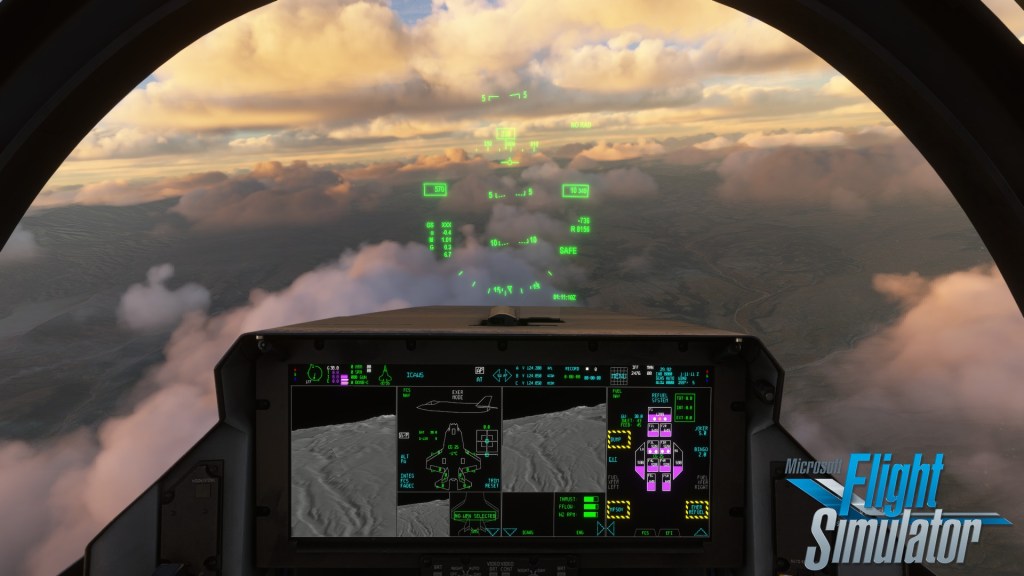
I saw some ill-advised comments out there including “nobody knows what the F-35 cockpit looks like” and “we have no idea what any of the systems do.” The first, is instantly disprovable with a simple Google image search. The second isn’t really the case either as there are plenty of public videos, often from tradeshows, where people are walked through how to fly and even operate some of the F-35’s systems in simulators that are purportedly setup to be the same as the jet.
I went looking and unsurprisingly, Military Aviation History on YouTube has a fantastic video showing us the simulator version of the F-35 cockpit complete with a walkthrough of a good number of systems. That includes sensors and weapons. I was actually kind of stunned at how much we’re now able to see in action.
If that all weren’t enough, we had a recent post by IndiaFoxtEcho on their Facebook page. The MSFS and DCS World developer have their own F-35 project for MSFS 2020 (and soon 2024) that is well regarded. They’ve done their homework and know how to develop for both sims thanks to the DCS: MB-339 and DCS G.91. Here’s some of what they had to say:
However, we have seen a lot of misinformed discussion about the potential “realism” that ED can achieve, as they declared it to be a “full fidelity” module and we’d like to clarify that we believe they can do an EXCELLENT job in terms of realism: contrary to popular belief, much of the required information on the F-35 air vehicle is publicly available (e.g. academic papers) and there are dozens of videos of cockpit simulators, showing the avionics and the pilot interface in great detail.
Moreover, a lot of the official aircraft documentation is APPROVED FOR PUBLIC RELEASE or UNCLASSIFIED (although some of the unclassfied documents, like pages of the flight manual, are actually parts of RESTRICTED documents) and can be easily found online.
Long story short, the F-35 is actually better documented than most people think – and it IS better documented than the F-22, and even (to a much lesser extent) than the Eurofighter.
That gives me a lot of reassurance that there is actually quite a bit out there and that together with just a few of the materials that I’ve looked at, which were all clearly generated by and aimed at a public audience, it seems to me that we know a decent amount about the airplane.

There is a caveat to all of that and again I turn to IndiaFoxtEcho to make this next point as well.
There are, however, some critical areas in the development, such as the actual performance of the radar and the sensors (that is CLASSIFIED) and the actual radar cross section (which can be, to some extent, simulated with commercially available tools such as HF-SS or CST).
Here is where the biggest challenge will be. But I also don’t think this is a new problem. How many DCS World modules do we have out there with radar ranges, as one example, that aren’t likely to be exactly what we expect them to be? There’s been countless arguments over the years on that issue alone. Eagle Dynamics and the third parties have been estimating and making all of this fit into the sim as best as they can for decades of DCS World and Lock On or Flanker before it.
It’s here where I think I can also safely say that if they do a rough estimate of what they think an AESA radar can do, based on public documentation and their estimate based on the simulations they already have in the sim, I think I can live with that. I wouldn’t know the difference if it was wrong.
There are some other interesting systems in the mix too. F-35 employs advanced jammers, something DCS World has historically not really touched very much (and may need to attempt further detail if they want to make the F-35 a little more real). It also has the Distributed Aperture System (or DAS) and the Electro-Optical Targeting System (EOTS). The sensors can, according to Wikipedia, pick out a ballistic missile at 800 miles and has a spherical sensor sweep around the jet that can help pick out ground vehicles, aircraft, hotspots and more. It’s like the targeting pods we already see on several DCS jets and then some.
And as classified as the details of these systems are, even Lockheed Martin shows off some of the capabilities right on their public website.
Is this all enough to build an extremely accurate simulation? I’m going to guess that more than usual will have to be done through educated guesses. Still, its not a total mystery and its one that with experience like ED has, can be speculated and inferred into something interesting and enjoyable for us flight simmers.
Does this change the “game”?
I do think this announcement does shift the ground under us a little bit, or it ought to.
The F-35 is just one airplane in a mix of aircraft in the DCS environment. It has for most of its lifespan been a bit of a mix of types of airplanes from all different eras and capabilities. The F-35 represents the first time that a so-called Fifth Generation aircraft will be in the sim. If we consider this from a multiplayer PvP experience, the F-35 is going to represent an outsized threat to the opposing players with the ability to see and react to the airspace unlike anything else in the sim.
I suspect it will be like the day after we first got Link 16 on the DCS: F/A-18C and suddenly I realized just how much I could see now thanks to the shared sensor information that we all now could see. The F-35 just amps that up a few more levels (and brings its own datalink too).
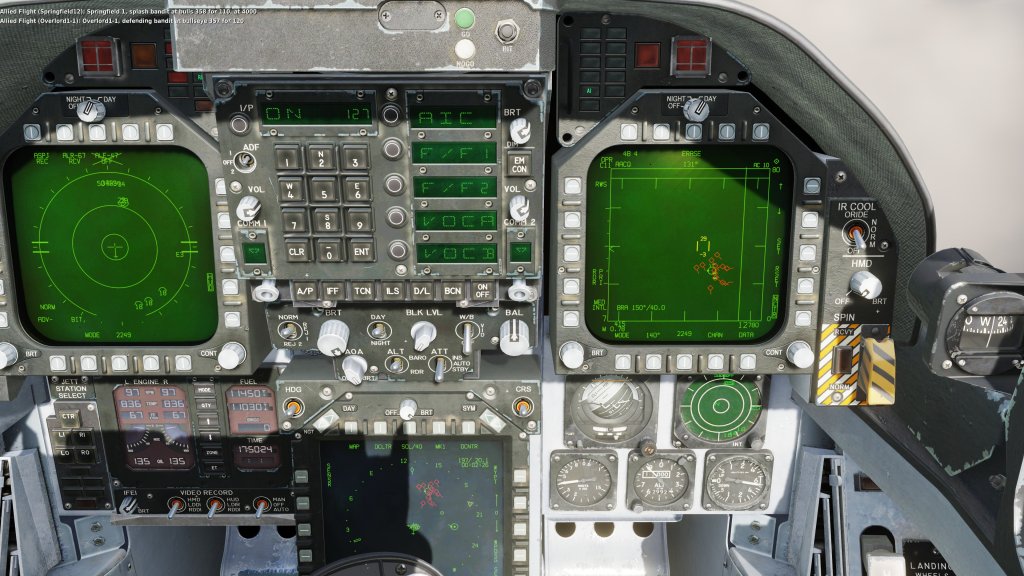
The response will be that some servers just won’t offer it, while others may find ways to restrict it or use it in a limited capacity. Still other servers will fully embrace it into the mix of aircraft. I can see it being more common on PvE scenarios than PvP for example and I think that’s ok. DCS has always been a sandbox environment, sometimes to its benefit and sometimes to its disadvantage, but it’s always let you play with whatever toys were available.
There’s another shift I want to talk about here as well and that is that we’ve jumped forward a decade (roughly) in what ED is going to be simulating. We’re going to hopefully see some additional assets brought forward that fit the era from ships to tanks to supporting and especially adversarial aircraft.
That together with the slightly more speculative nature of the experience suggests to me that the door should be open to types previously not considered possible. It may well be that several Russian types remain off limits for now (laws and other considerations) but we’re surely getting to the point where the Su-27, just a few years younger than the MiG-29, will start to “age in” to a spot where they can finally return to it.
There’s also a whole host of aircraft from the 1960-80s (some well known British types for example) that were off limits due to restricted documentation. I think these should potentially be on the table now. Let’s make a few educated guesses plus use the well known technology from the era that is available to provide for a mix of simulated realism and accuracy. This won’t make everyone happy but I think it will make more people happy than not.
Is this all good for DCS World?
This is the hardest item to consider because unlike my earlier points, this one is very much going to be a subjective view on how you see all of the stuff already talked about.
The F-35 will surely be disruptive to the sim just with its presence. It shakes the notion that DCS World modules are deeply researched aircraft relying on highly detailed sources alone, it brings in new capabilities that no other module has, and it moves the sim forward anywhere between 5 and 10 years in advancement of simulated hardware.
We’ve heard word that MicroProse plans to incorporate more modern types into their planned Falcon 5.0 release. If and when that project arrives on our computer screens, it may well offer some serious competition and so announcing the F-35 now may well be an attempt to try and get a leg up on the competition before it arrives.
It may also be a boon to the pocketbook for Eagle Dynamics. While older simmers will feel nostalgia for the Vietnam era jets like the F-4 Phantom, and slightly younger ones may feel similarly about the 1990s to 2005 era jets like the F-16 and F/A-18, a whole new generation of simmer has seen types like the Typhoon, Rafael, Gripen, Su-57, F-22, F-35, and F/A-18E/F take over the limelight. They want to load up DCS World and fly these newer airplanes and I understand that impulse. And even these, “new” aircraft aren’t new anymore. The F-35A’s first flight was 19-years ago for example!
I also want to put it out there that while we’ve all expended a lot of time thinking about the F-35, the core of the sim is what DCS World really needs to continue to work on. They have been but the pace has felt slow at times and everything from ATC to radio to AI needs to continue to evolve. An infantry-man with an AK74 shouldn’t be able to get a sniper shot at you from kilometers away, air defense batteries shouldn’t be able to acquire you behind a hill, DCS single mission generator is desperately needed to provide us with non-dynamic campaign quick missions, etc. They are working on these things but as much as any new plane is going to be the talk of the town, the sim really needs its core to be beefed up. That’s what really matters. We can choose to fly or not fly the F-35, we can choose to have it in our scenarios or not have it there, at the end of the day it’s another interesting module in the mix.
Final thoughts
No question that the announcement of this module is a bit of a surprise and one that has many of us questioning just about everything about DCS right now. As chaotic as that may be, I think it’s a healthy thing for everyone to maybe re-evaluate how we see our simulations and what they mean to us. For some, the F-35 is going to involved too much guess work while for others it offers hope to open the door on some types that may not be otherwise doable without a bit of guess work. I hear both of those arguments loud and clear too.
How it all shakes out, we’ll have to see, but I think we’ll be waiting for a bit as the project is reportedly aimed at 2026. I’m going to call it right now and say that I think maybe 2027 is more of a good guess? We’ll see where we all are then. If DCS can offer me a similar experience to the one shared on Military Aviation History with a flight model that’s based on whatever public info they have and a pretty good CFD simulation, I think it’ll be happy and interested to see what all of the fuss is about. And some folks won’t be interested in it and that’s ok too! For the record, I’m just as jazzed about this as I am types like the F-100 and the G.91. Everything that flies is of potential interest to me… I’m just like that!
Also, while we’re thinking about the future of the sim, I haven’t once mentioned DCS: F-15C in all of this which, after the dust has all settled, is going to be a great return to the classic air superiority fighter that was one of the backbones of the Lock On: Modern Air Combat series. How great will that be? With some new features it should be a blast to see return to the sim sometime within the same timeline.
That’s just about enough but I do want to sneak one more section in…
What other folks are saying
Lots of folks are posting their takes on all of this and there are some interesting points of view out there to consider. Enigma did one that had me thinking a lot while I was in the midst of writing my own take.
Always interesting to hear from Mover and Gonky bringing their real world experience to the table. I liked their comments in particular about how even the real world jets don’t always perform the way that they should and that very expensive simulators aimed at training real pilots aren’t perfect either. A solid dose of reality there.
AIR WARFARE GROUP and Pricklyhedgehog72 have an interesting discussion about the challenges and pitfalls of the addition of the jet into DCS World as well.
There are many other examples out there but all food for thought.



 Stormbirds
Leave a reply to Bumfluff Cancel reply