

There’s a relatively new joystick on the block right now from well known hardware maker VIRPIL. Their CDT-AEROMAX-R Flightstick is a mid-market compliment to other parts of their portfolio. This setup offers something a little smaller and shorter than some of their other products and it seems to be aimed at tabletop users as well as those who have fancy mount setups. How does this offering compare to other products out there and might this be the right setup for you? Let’s have a close look at the Aeromax! Here’s my review!
Disclaimer
VIRPIL Controls sent me a CDT-AEROMAX-R Flightstick with the optional axis attachment for the purposes of writing and ultimately reviewing this piece of hardware. When these arrangements happen I always let my readers know about it. VIRPIL gets to read this when you do and has not made any editorial suggestions. The contents of this piece are entirely my own.
Unboxing it



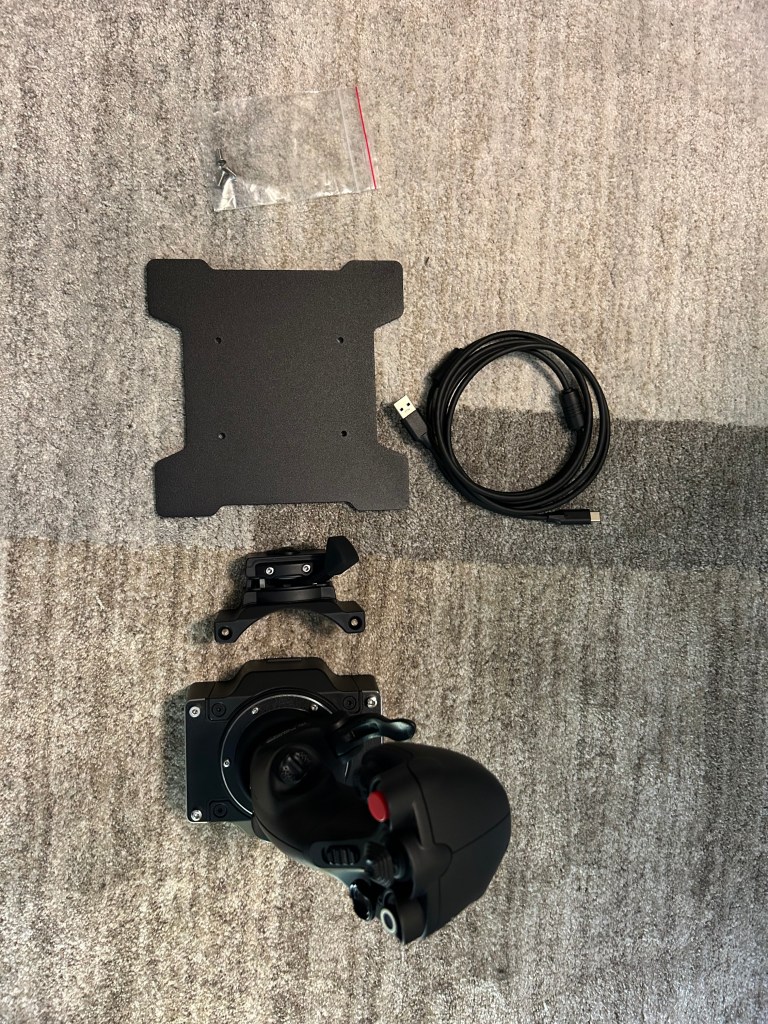
The unboxing and setup on this stick is quite straight forward. The joystick comes packaged with everything you need right out of the box so it only takes a couple of minutes to unwrap it, put the base plate on if you intend to use it on a desk.
My package did included the optional throttle control axis which you can very quickly bolt onto the side of the unit. It automatically connects, and then with the software, you do the calibration and setup before using it. One of the simpler setups I’ve had to do over the years which is great!
Setting it up
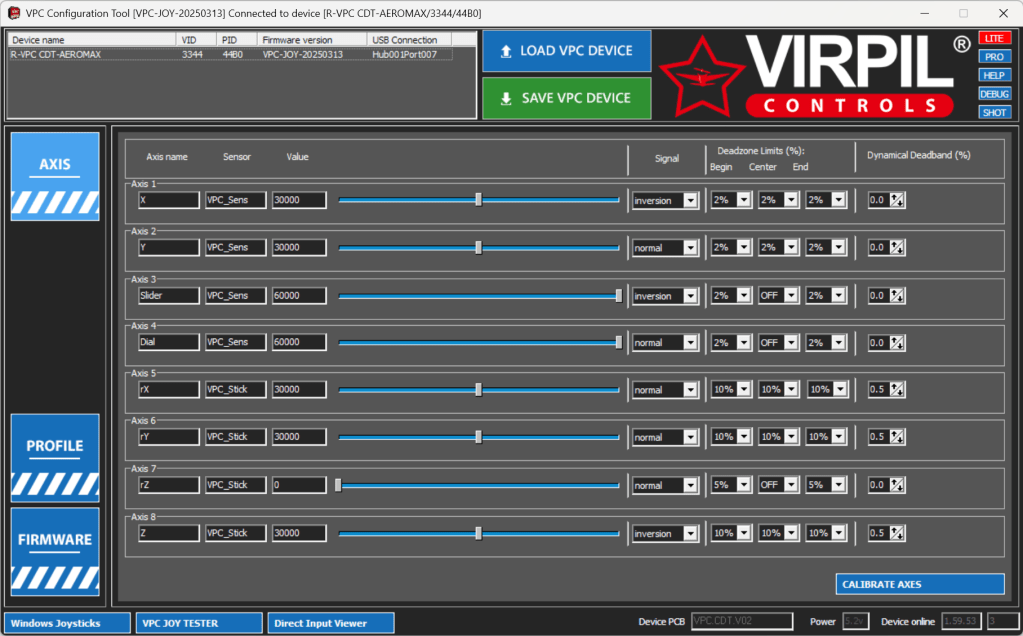
When I did the initial setup, the new VPC Cadet Configurator (Beta) hadn’t yet added support for the Aeromax so I flipped over to the old reliable, if a bit utilitarian, VPC Configuration Tool. This works works just fine with the new stick. So, if you’re preferring to use the old tools it works fine.
With the Configurator, I was able to connect to the AEROMAX and do the usual profile setup and axis calibration process that you see with other VIRPIL products. If you’re new to VIRPIL, its essential that you run the software and do the calibration and setup which will then update the memory on the device and make sure that its ready to go. It’s been my experience that you rarely need to do the calibration after that initial process as VIRPIL’s contactless sensors and software aren’t prone to the kinds of drift that you used to see with joysticks from yesteryear.
Since that time, the newer versions of the Cadet Configurator have added support for the Aeromax and you can use that for the process as well. It has a fancier interface that is easier to approach than the older software so if you’re just starting out, this is the one to go with. It makes it a lot easier to setup the stick’s settings, flashing and updating the firmware, configuring its LED lights, the Z-axis and other controller preferences. Need to split the device into multiple 32-button controls for older software? Click of a button. I really like the new interface so I’m glad to see it coming along as part of the evolution of VIRPIL hardware.
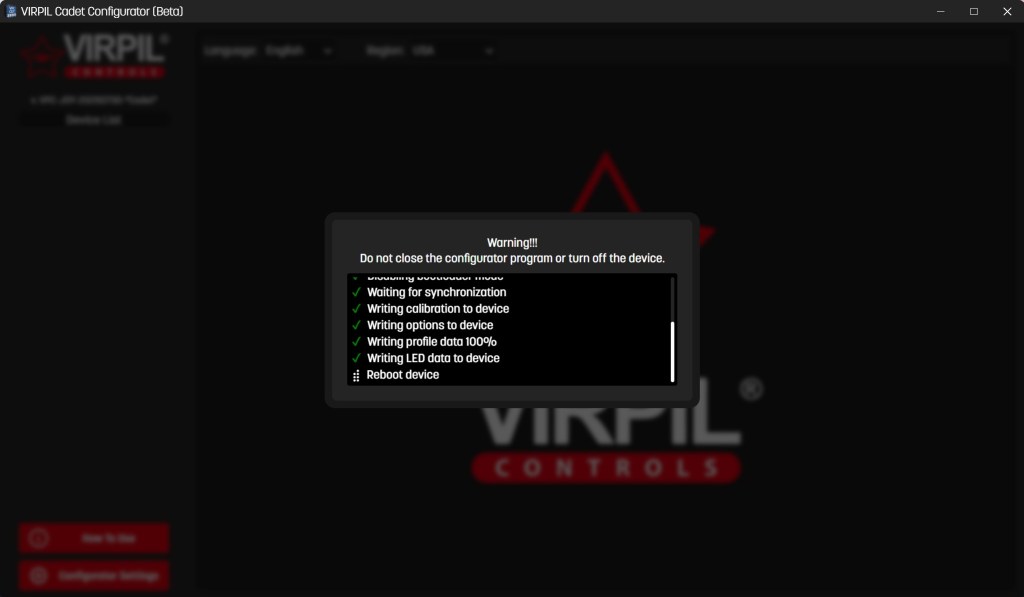
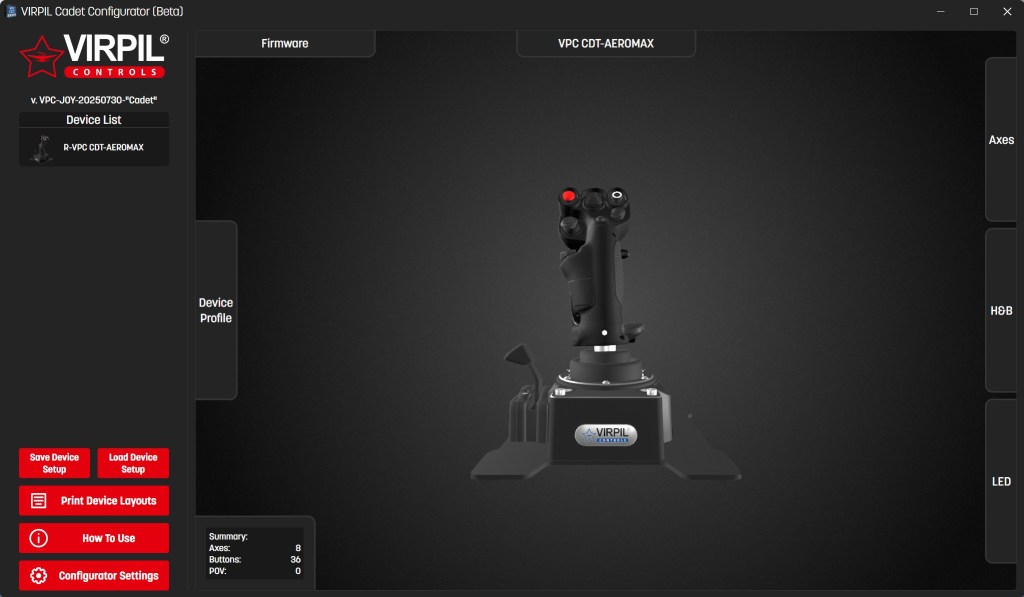
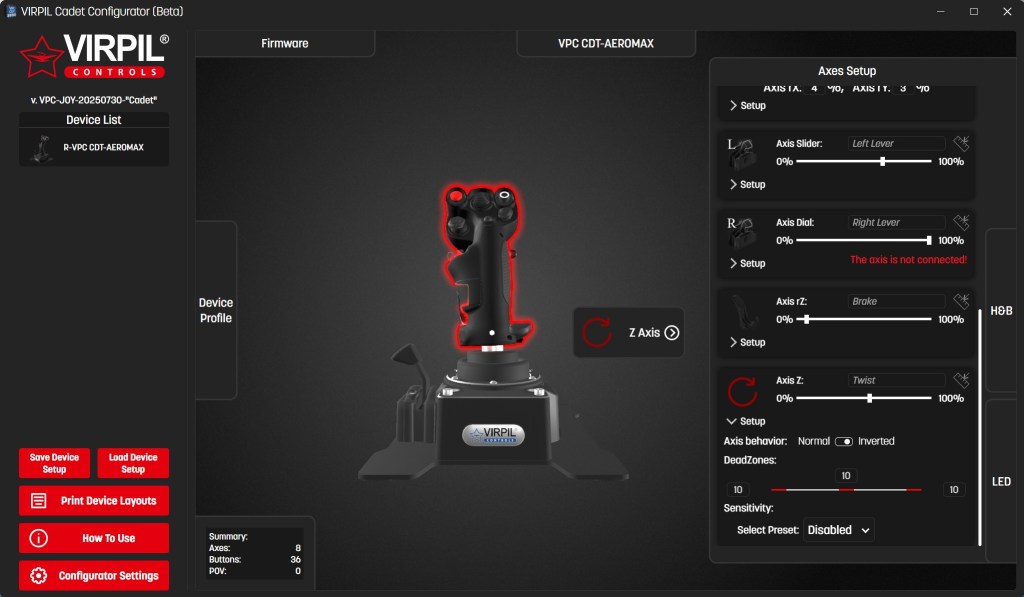
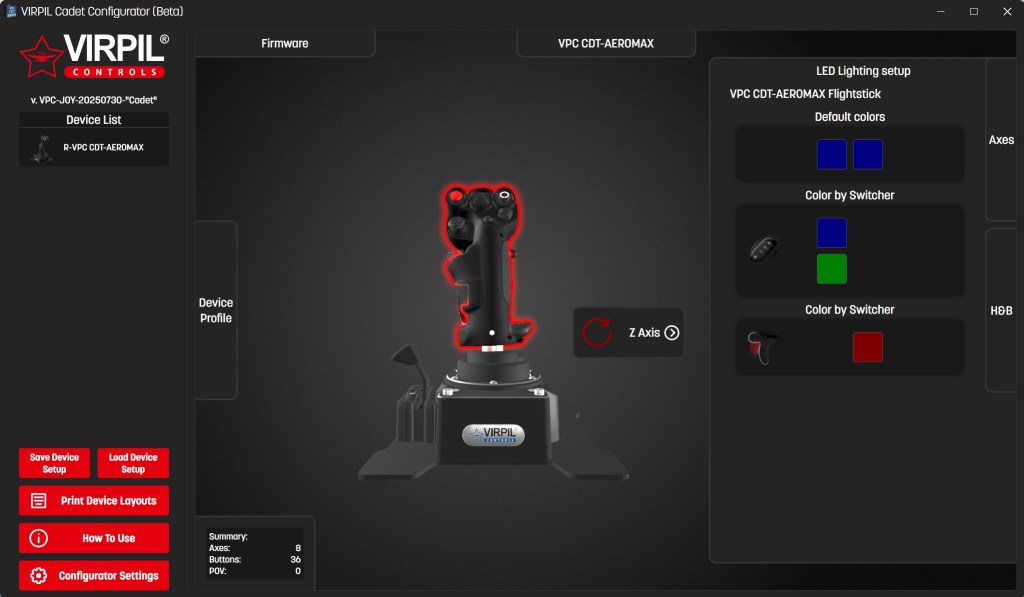
After that setup process, it’s just a matter of loading up your favourite sim and binding the controls and getting to the flying!
The hardware
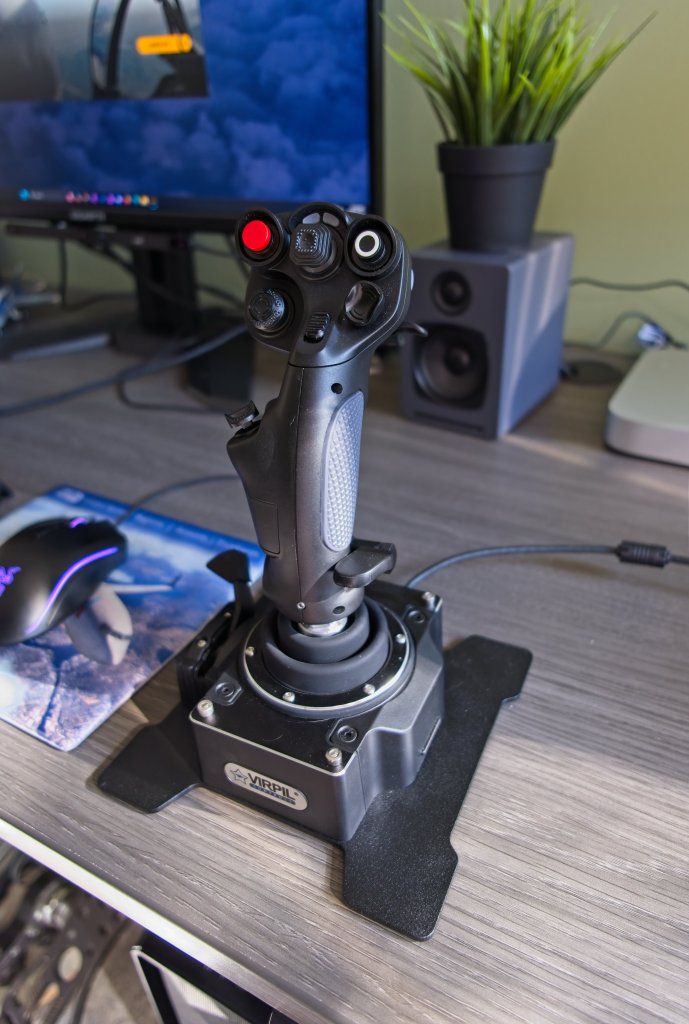
VIRPIL have been making flight sim hardware for around a decade now. The company has gone through more than a few iterations of different types of sticks which have been in the mid and higher end market. Its a position in the market that they still command a sizable fanbase thanks to their all metal component designs and premium offerings.
This is the cheapest combination that the company offers coming in at MSRP of $219.95 USD or €189.95 in the EU. That instead of €219.95 for the WarBRD-D base and €119.95 for the Aero grip.
But it does make a few compromises and some market specific considerations to achieve this cheaper price. That starts with its all-in-one design that eschews the separate base and grip combination system that they’ve used on higher end products. Instead, the base and grip are integrated together.
The stick is also shorter when compared to the company’s WarBRD series. That model is really too tall for lengthy tabletop use and works best on a mount. The CDT-AEROMAX is somewhat shorter in practical application and that makes it better positioned for desktop use. They’ve managed to trim down their earlier designs into something quite a bit more compact and that makes it a far better contender for a desktop grip.
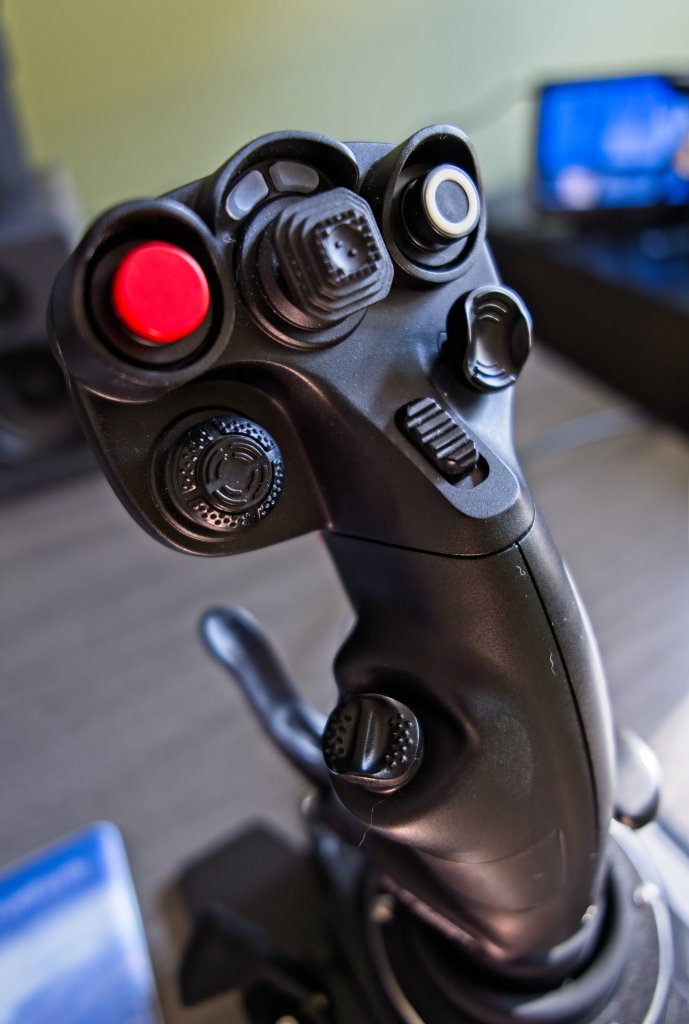
Let’s talk about the grip. One of the last grips I tested with VIPRIL was the WarBRD (base and grip review here) and while it was quite a solidly built stick, I can say with some confidence that this Aeromax grip is quite a bit better from a human-ergonomics perspective. The shape of the stick conforms to my hand better than the old one did and thanks to an easily adjustable hand grip, you can make it so most hand heights will work well on it too. No small surprise then that this new grip has replaced the older WarBRD grip on their store in recent months.
Most buttons, hat switches, and analog controls on the stick are easily reached even with average sized hands. The paddle switch button is the only one that I find is a little difficult to get to and it feels like it should have been something that you’d reach around with your pinky finger. For me its just a little too far around the grip. Instead, I have to use my thumb with it… or not use it at all. It feels a little awkward in what is otherwise an ergonomically excellent stick.
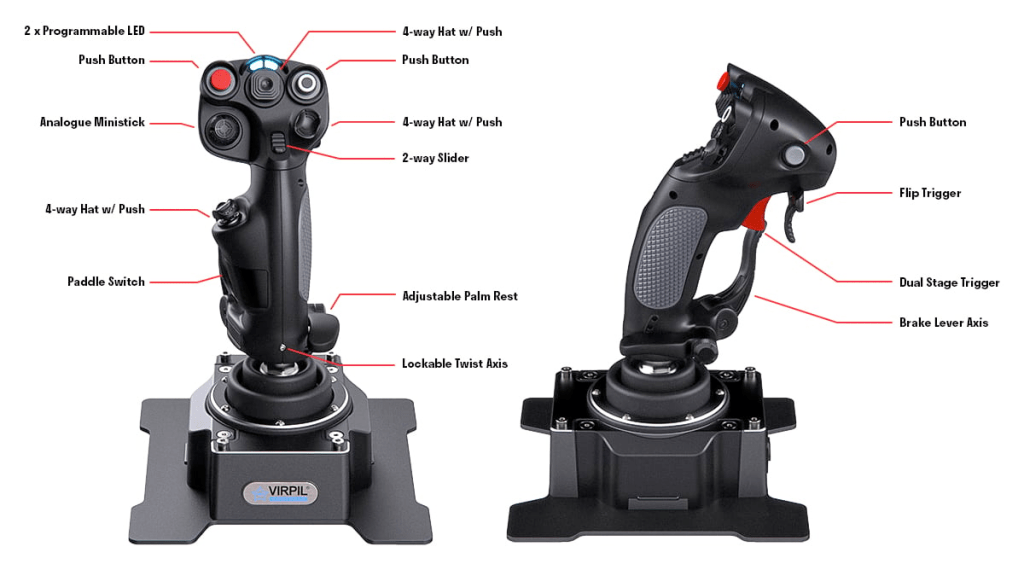
One of the other things that almost immediately stands out is the number of controls on this thing!
Here’s the tally: A two stage trigger, secondary two stage trigger that flips down, a brake axis, two top buttons, one side button, a slider, three four way hat switches with push action (so five actions total), and an analogue hat control as well. Oh yeah, and that aforementioned paddled switch on the side. If you do flight simming with any kind of combat aircraft or with an airliner, you can potentially bind most of your controls to this stick without even thinking about a HOTAS throttle unit. I’m not saying that’d be the ideal setup but you could do it such is the flexibility.
I found the brake axis to be direct, accurate, and it works great for aircraft that are setup with a single brake axis system.
VIRPIL has also made a side axis throttle control available as an optional and very reasonably priced add-on. It is easily attached with two screws and an Allen key (or Hex key). It took maybe 2-3 minutes setup and run the calibration to make it work. It’s symmetrical so if you purchase two you can put one on each side for different controls.
The throttle has a relatively short throw and light touch is all that’s needed to move it. That could be a little difficult for very light adjustments to throttle, however, it is generally good enough for most kinds of flying. It moves smoothly and stays in place once moved. If you don’t have the cash for both stick and separate throttle, get this one and think about doing an update later.

The base of the stick is made out of machined metal with smooth edges and the stick is made of a strong plastic. It may be plastic but its the kind of moulded plastic that is thick and strong and displays no visible warping under pressure. It feels absolutely solid and I doubt will show any significant signs of wear for a considerable time.
The side of the stick has a grey textured piece attached that helps with grip. Useful for those sweat inducing moments in flight simulation!
The insides are all metal and that’s what really begins to distinguish this from more inexpensive models. That gives it a solid feeling that is unmatched by cheaper models with primarily plastic interiors. The base is also screwed into a metal plate for added stability while desk mounted. The plate comes with an up and down configuration with the bottom having four rubber grips for added stability.
Mounting this unit is a little more interesting. It doesn’t fit the full size mounts previously offered by the company and is instead part of a separate line of mounts. They aren’t here yet but are expected to be out sometime soon though it looks like we’ve gone past the initial planned for date of September.
In action
I’ve been testing the CDT-AEROMAX for a few months now. I’ve used it with World War I, World War II and Cold War and Modern-era combat aircraft in IL-2 Sturmovik and DCS World. I’ve also used it with gliders, helicopters, and airliners in X-Plane and Microsoft Flight Simulator. That gives me a wide perspective on how this stick works in different scenarios.
The first thing that stands out is the flexibility afforded by this package. As a combat flight simmer flying complicated combat jets, having three hat switches on the top of the stick isn’t so much a luxury as nearly a necessity to manage all of the systems. Especially if its a DCS aircraft like the A-10C, AH-64D, F/A-18C or innumerable other models. From selecting weapons to directing sensors of interest, to setting the trim and more. All of those hat switches can be used for those tasks. In less complex aircraft, they still let you have quick access to specific tasks. For example, in IL-2 I use one of the hat switches to toggle bomb and rocket drop salvo settings quickly switching between single, dual and salvo fire without having to move my hand off the stick. That’s the kind of flexibility you have with this many controls.
The hat switches are, after several months, still feeling like new. Over the long term I can’t say how they will hold up but right now they feel solid and should be good for long term use. The movement is, in my opinion, just a little short but they do have a discernible click so you know you’ve activated them. Same goes for the push mechanism. I haven’t had much chance to use the analog control but its very smooth and precise in testing.
I have had a good opportunity to use both sets of triggers. First, the primary trigger (the red one) is really great! It’s a two stage trigger and VIRPIL have made sure that both the first stage and the second stage have discernible clicks. Great for warbirds where you may want to have machine guns on the first stage and full guns on the second stage. Or useful for aircraft like the MiG-29, A-10C or F-5E where the first stage is useful for activating systems like the gun aimer, the PAC or the gun doors respectively. The transition then to the second stage is easy with a smooth transition to firing on the second stage. I think this is a better implementation of the two stage trigger than they did on the older WarBRD grip actually. It’s really excellent!
There’s a secondary, flip-down, trigger also available. I find that useful for some aircraft such as warbirds with dedicated secondary firing switches – like firing your rockets off in the IL-2 Sturmovik series. This is also a two stage setup so the flipped up position is off, the flipped down position is stage one, and the full pull is stage two all triggered by the hardware. It’s easy enough to grab and position with your trigger finger for stage one and then pull for stage two. It’s a little lighter on the actuation than the trigger so you can’t mistake the two. I do find the actuation here a little spongy though it hasn’t hurt my aim.
The actual stick movement isn’t something I’ve talked about much yet so let’s do that right now. It’s very smooth the way only metal cams and springs can provide! That means that, together with their contactless sensors, even very small movements are registered precisely and you, as the analogue human at the end of a lot of layers of digital systems, feel like you’re controlling the aircraft in a little more realistic way.
It does ramp-up in resistance as you move it through to the stops which is good for most types of aircraft in that it gives you stick feel and is an artificial way of making you feel wind resistance on the controls. It is, however, less ideal if you’ve got just the one stick and also want to fly some types of helicopters or World War I aircraft with no trim and you find yourself needing to hold the stick in-place for longer periods of time.
The whole setup is, out of the box, quite stiff as it was with the WarBRD. One of the issues with a short throw stick on a desktop is that it can make for some difficult ergonomics for desktop operations versus a longer traveling mounted stick. Your experience may vary but if you like a finger light movement style, the default configuration here may not be for you. If on the other hand, you want to feel the act of moving the controls then I think you’re going to love this.
Comparing the marketplace and pricing
I first saw the CDT-AEROMAX back at FSExpo 2024 in Las Vegas and it immediately caught my attention. It was immediately apparent what VIRPIL had planned here.
VIRPIL have done well in the mid to high end of the market offering a couple of very capable bases, the WarBRD and MongoosT series, and a whole collection of grips to sit on top of them. Metal components, dual cam designs, adjustable tension systems, and quality construction have made them stand out in an increasingly crowded market.
What VIRPIL has lacked has been an answer to the more middle of the road marketplace. This has, until recently, been solidly dominated by VKB-Sim’s Gladiator NXT (and now NXT EVO) stick which combined low price with some middle market features. CDT-AEROMAX is aiming at this part of the market albeit with a slightly higher MSRP of $219.95 USD or €189.95 in the EU. The Gladiator NXT EVO is around $100 cheaper (listed at $119.00 USD) while the also still new WinWing URSA Minor fighter joystick is about the same ($123.55 USD).
Meanwhile, the higher end offerings are roughly $100 USD above the CDT-AEROMAX so while its priced higher than its closest competitors its also quite a bit cheaper than the next level and I think there’s room to shop around here.
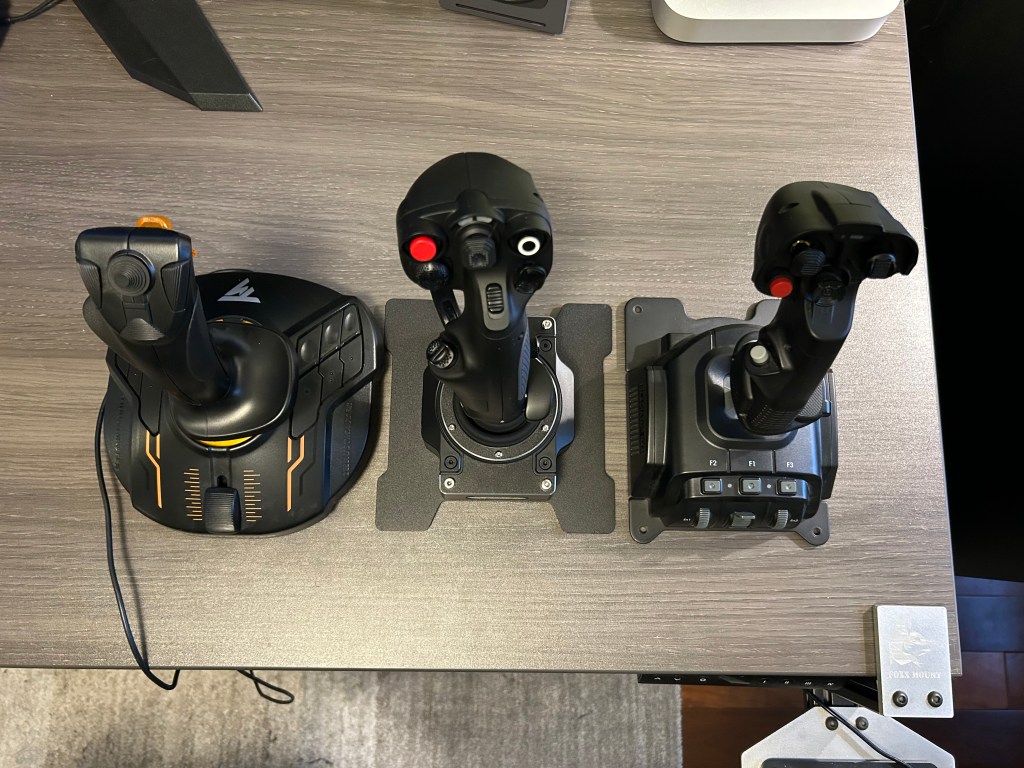
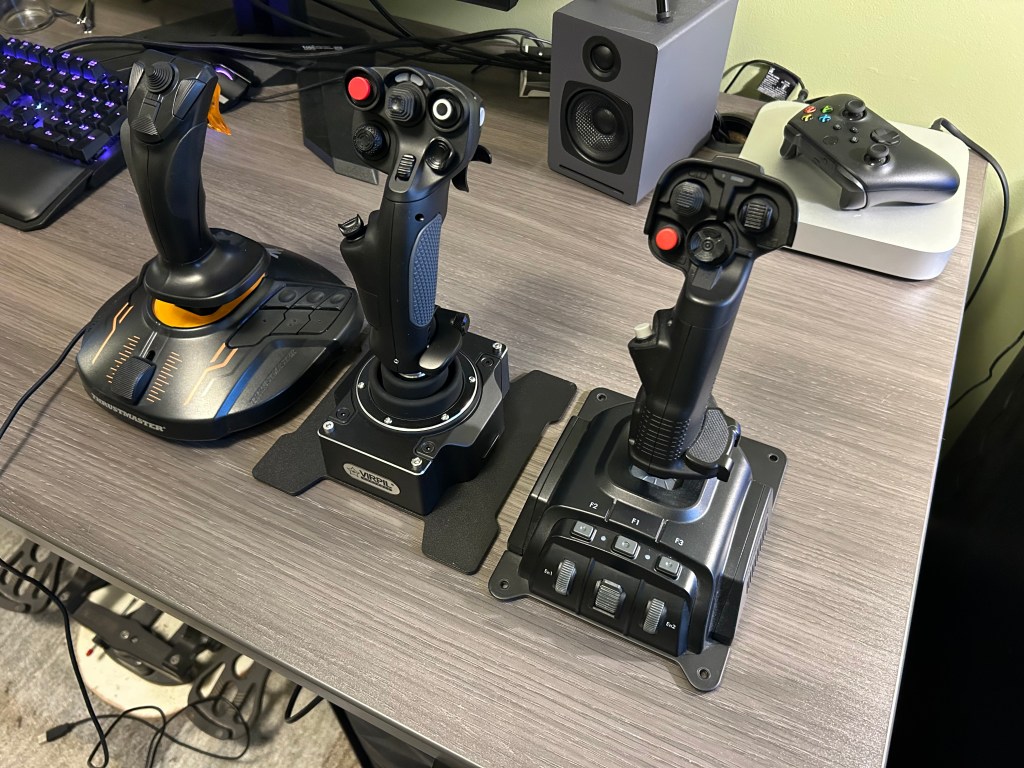

It would be remiss if I didn’t mention that, depending on your location in the world, there may not be trade barriers or tariffs applied to your purchase. You will need to factor that in when purchasing any flight sim hardware. VIRPIL’s Lithuanian factory shipped products, for the moment, may have fewer barriers than their competitors which may bring pricing to a similar level. Or by the time you read this it may have all changed again. My advice? Before ordering any of these comparable models, consider tariffs, duties and other fees applicable from your location and save yourself some sticker shock.
One other piece worth mentioning. It’s also very clear that CDT-AEROMAX is just part of a product line of mid-market priced offerings. AEROMAX naturally pairs with the CDT-VMAX Throttle which is similarly aimed at the mid-market. It also has a few less features than the higher end offerings while still being built with metal base, components and high grade sensors. You can match it with anything but I think the idea here is to provide some obvious, middle of the market solutions, for those who are price conscious but with at least a bit of money to spare for hardware.
Final thoughts
The thing that is most remarkable about the CDT-AEROMAX is what is on offer for the price that it is offered at. This is a stick that essentially takes most of the features of its higher priced cousins and packages them into a slightly more compact offering at a lower price. It trades the ability to swap grips to achieve that goal but otherwise offers a very flexible, usable, and comfortable to use grip.
I place this firmly in the middle of the market. Its not the higher end offerings with replacable and swappable grips but its not the lower end of the market with all plastic cheap feeling materials either. If VIRPIL was seeking to directly compete with VKB and WinWing on their lower priced offerings, the CDT doesn’t manage to do that. Instead, I think they are offering a compelling option that, yes, costs more, but offers a more premium package while still being quite a bit cheaper than the high end offerings. I suspect there’s quite a few sim flyers out there who are willing to pay a bit more but have no interest in swapping grips or going the extra level of customization and that’s what this CDT-AEROMAX is all about.
The optional throttle is nice to have but also unnecessary if you have a throttle system already in place. On the other hand, if you don’t have one and you just want everything in one package, you can absolutely make good use of this for basic throttle work.
My only real complaint is a personal one. I’ve shifted over the years from the desire to have a relatively stiff stick that simulates stick pressure as you move to the edges over to the other extreme where I’m now wanting a relatively light throw. This stick currently doesn’t have lighter springs as VIRPIL’s WarBRD does and so you do have to like a slightly heavier stick feel. Some of you are going to like it but for me it does make it feel fatiguing after lengthy scenarios.
The bottom line here is that VIRPIL has planted a flag in the medium end part of the market where they previously had limited offerings and they did it with a stick that has a superb list of features, great quality of materials, and solid support that ensure that its going to work in nearly any flight sim you can throw at. If you’re a casual or even enthusiast flyer looking for something that is durable, can handle a lot of different situations, and is easy to setup – this may be the sweet spot that you’re looking for. It’s a bit more than the competition but you may find it worth it to spend the extra cash.
I know production rates have also been a problem for the product. That said, recent announcements suggest that VIRPIL have surmounted those and products are shipping to customers. While quantities in this kind of space are always limited and products are nearly always listed as “backordered,” the company has, in my experience, been pretty good at fulfilling that back order consistently over time. I hope the few of you waiting for your product to arrive have seen it arrive and, if you’re reading this months later, I hope that product continues to flow at reasonable rates. You will nearly always end up waiting a bit to get one but I think the wait, as you can read from the review, will be worth it.
If you’re an enthusiast looking for a new stick setup either by itself or with a throttle, I highly recommend that you have a close look at VIRPIL’s CDT-AEROMAX stick.
Available storefronts:




 Stormbirds
Leave a comment