
With two powerful turbofan engines, advanced aerodynamics, and a long running reputation across decades of use, the MiG-29, NATO reporting name “Fulcrum,” is certainly one of the most fascinating aircraft to come out of the Soviet Union during the later stages of the Cold War. Its no surprise that fans of combat flight sims have often wanted to fly the jet and try it out for themselves. Eagle Dynamics have answered the call to bring the legendary Fulcrum up from its more basic Lock On: Modern Air Combat roots (where the modern Flaming Cliffs MiG-29A/G/S comes from) and develop a full fidelity DCS World level experience. And they have! But is it any good and should you buy in now during early access or wait a while longer? Let’s have a look!
What we always wanted

DCS: MiG-29 is a community wishlist item that has been fulfilled. Around the time we started to see more fourth gen Western aircraft added to the sim, community members started asking for Eastern-bloc airframes that could compete in multiplayer matches. The MiG-29 is one of those aircraft and it is here now! That won’t subdue the calls for more, the Su-27 Flanker for example, but getting the Fulcrum into place is a rather large checkbox.
There are some early access issues, which I’ll get to in the next segment, but I want to tout some of the positives here first and that starts with the fact that we now have a high fidelity MiG-29 experience for the first time. This is a DCS World level experience, following the footsteps of dozens of past examples, with depth to the simulation of the aircraft, realistic procedures, and access to some interesting systems like the aircraft’s IRST (infra-red search and track), laser range finder, and of course we now have a more detailed simulation of the MiG-29s radar and radar warning systems.
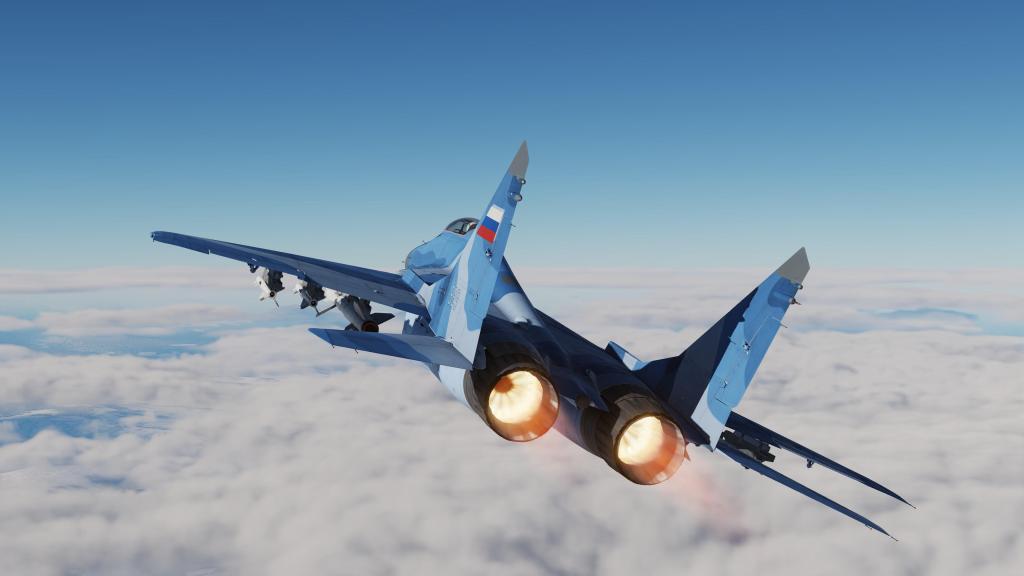


Because its a full fidelity airplane there’s a lot more subtlety with these systems than before and so that extra layer of detail brings with it both abilities and limitations – realistically so.
Some of those limitations? The SPO-15LM “Beryoza” radar warning receiver can’t receive forward hemisphere warnings when the aircraft’s own radar is on and transmitting. The same story goes for the aircraft’s fire control radar which is pretty good at picking up head on targets but needs manual adjustment if they are flying away from you lest they be lost in the noise gate. Being effective with this version of the MiG-29 is more difficult than the Flaming Cliffs version, but that’s largely what we wanted to see.
There are benefits to the in-depth simulation as well The aircraft’s IRST system, basically a heat seeker missile sensor strapped to an airplane, has adjustable sensitivity settings so you can fine tune the track and pick out a target in the noise. There were no provisions for that before.
We also now have a more detailed simulation of RSBN radio beacons, direct and toss bombing options for ground attack, and detailed simulation of the aircraft’s INS complete with realistic drift.
Eagle Dynamics didn’t cheap out on the model either with a rebuilt 3D model inside and out. There’s a laser-scan derived cockpit which looks magnificent. It has the kind of details that make it look slightly worn without looking like it was put through a blender. There was nothing wrong with the old cockpit for the Flaming Cliffs variant but this is better!

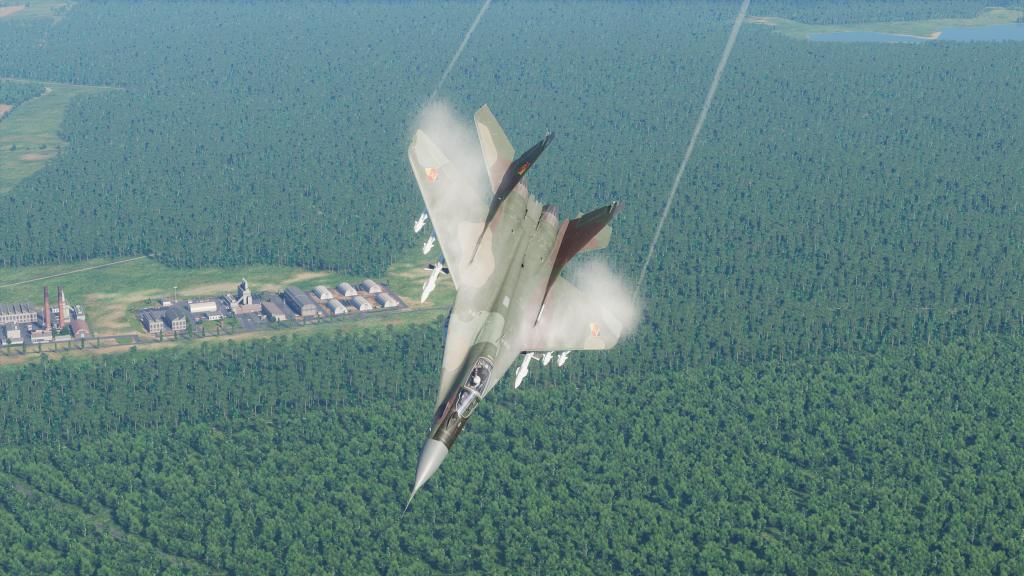

There are lots of nice little details in this aircraft too. It has Eagle Dynamics new tire deformation technology so if you zoom in you can see the tires deform based on weight. The intake louvres are dual mode with the doors closed while doing a take-off and opening up once in the air. The intakes on the top of the aircraft provide an alternate means of letting air into the engines when the primary intakes are closed. They also activate in some high alpha situations which is cool to see. The MiG-29 has what is probably the second best visual depiction of over wing vapours bested only by Heatblur’s F-4E Phantom’s vapour system. The Phantom is unbelievably good but this one is right behind it.
We already have ample options for the MiG-29’s usability including Russian and English cockpits and an option to convert the units from Metric to Imperial. A 3D model of the pilot is optional and welcomed by many.
The MiG-29 is also a bit of a rocketship. It’s got so much power and so much lift that its one of the more enjoyable aircraft to fly with the ability to carve a hole in the sky like few other aircraft. In terms of pure fun factor in flying, the MiG-29 is just fantastic. Its not without quirks (try pushing the nose forward at high speeds and it feels like concrete) but that’s part of the appeal.
It’s got all of this going for it but there are also some issues so let’s talk about those next.
Early access issues
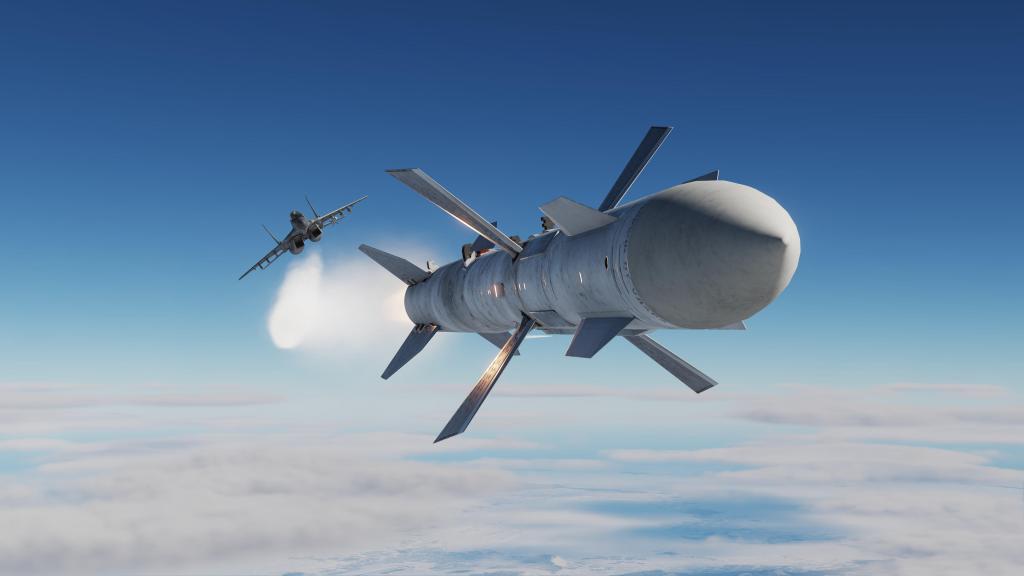
Before getting too much further into this, I want to point out that DCS: MiG-29 is in early access and like with nearly every early access release, there are some areas that aren’t done yet and there are some rough edges to smooth over. MiG-29 has several.
One annoying one is autopilot induced oscillations around 500 km/h. The aircraft will begin to buck up and down causing for some unpleasant flying. I’m not sure if it gets worse over time but I’ve usually left the autopilot off.
IFF remains a bit sketchy from my experience with it. This was listed as a fix but I think I’m going to need more time with it to see if the, still basic version of IFF, is working at all. Later on in development a more sophisticated simulation is reportedly going to be on offer.
There are other issues that I’ve been looking into as well. Asymmetric missile loadouts (i.e. mixing an R-27ET and ER) are currently not possible though my limited reading on the matter suggests that it should be possible – happy to be corrected if I’m wrong on that!
Since the initial launch, the MiG-29 has picked up a basic visual damage model. One wasn’t present right at the point of launch (a missile hit would cause the control surfaces to pop off and fires to appear but nothing else) but now it has what they are calling the first iteration of a visual damage model. Something is better than nothing!

Some other issues are more simply characterized as a lack of content. There are a decent number of single missions shipping with it but we do lack instant access missions (being available only for Caucasus at the moment).
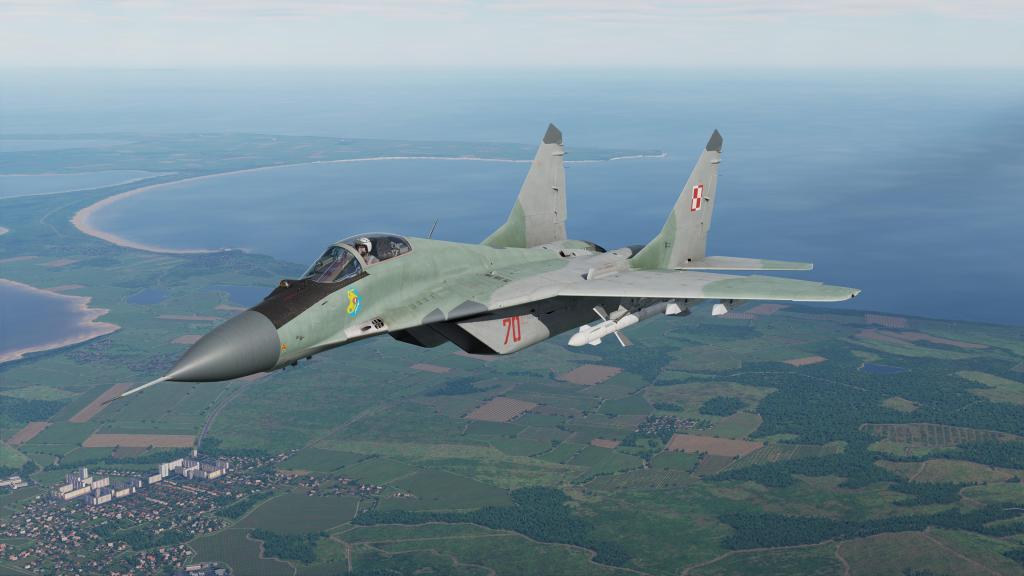
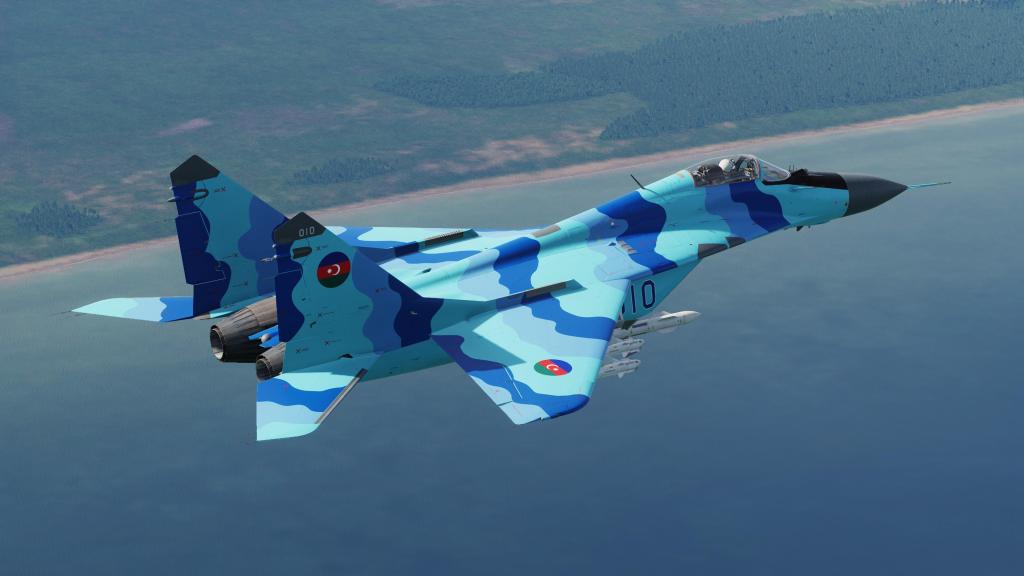
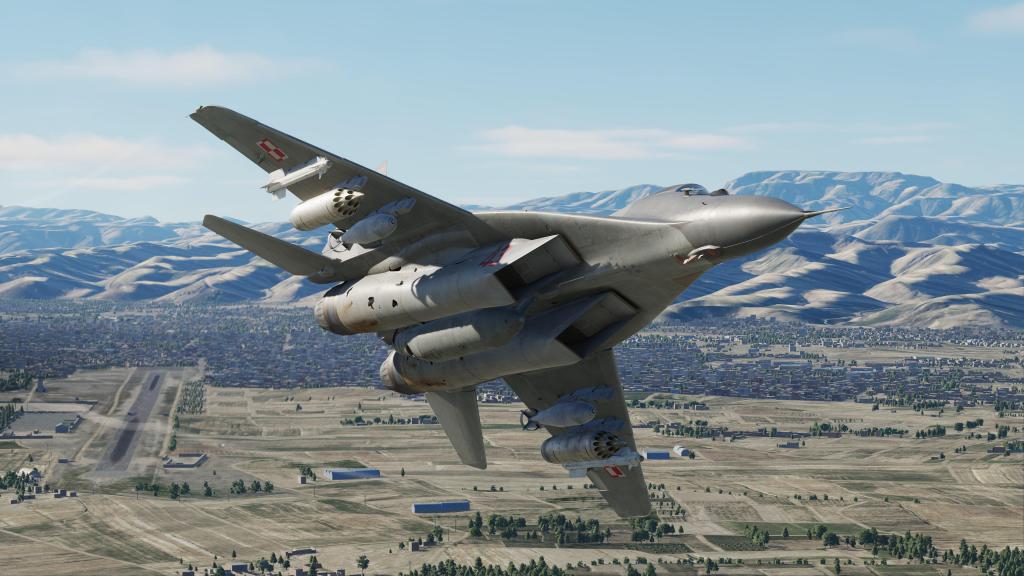
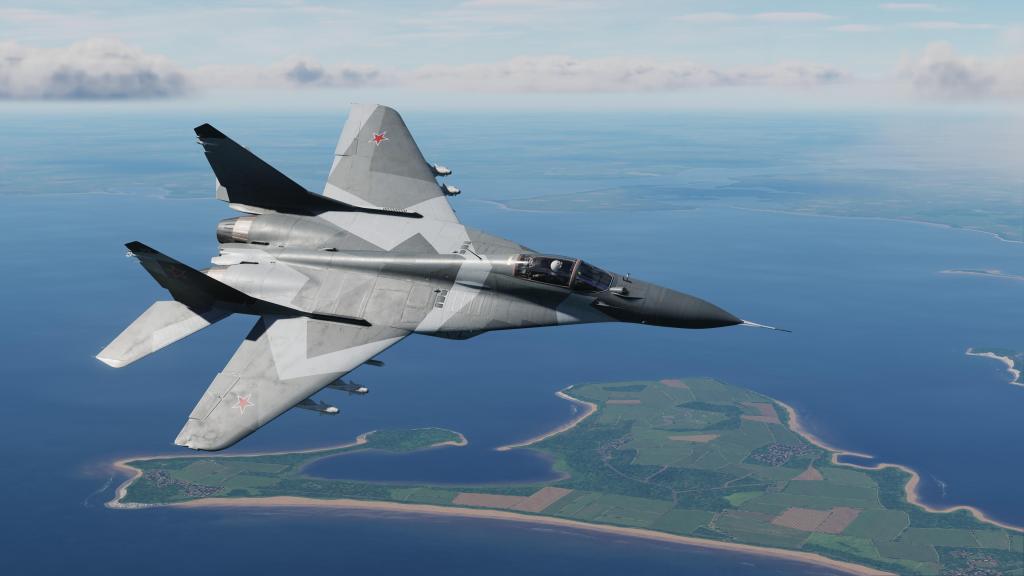
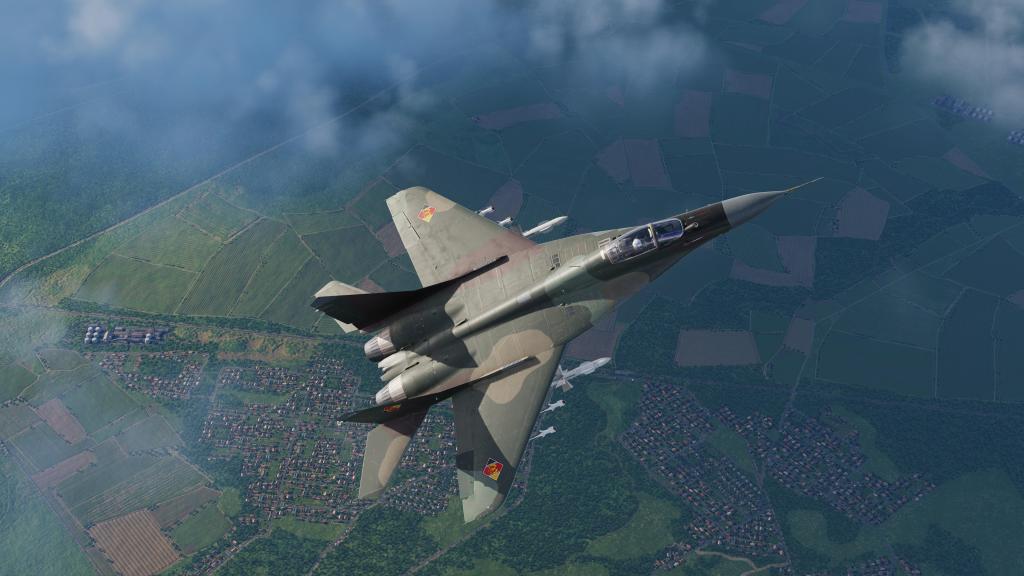
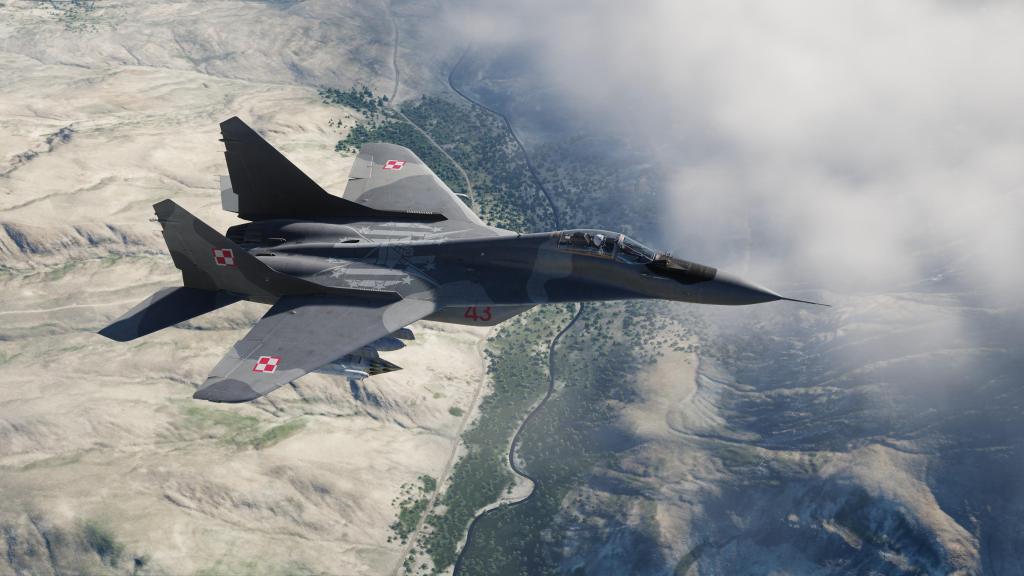
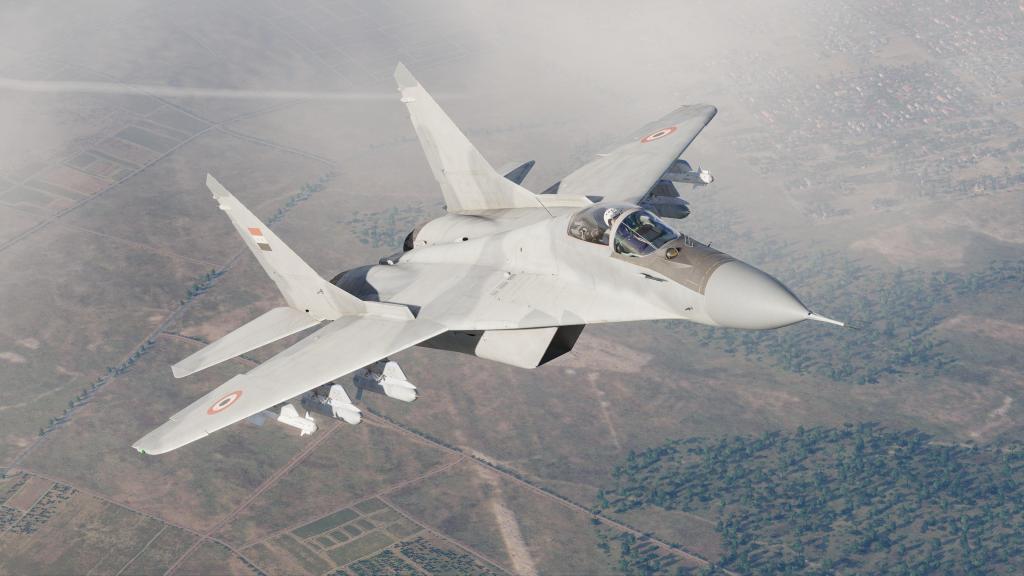
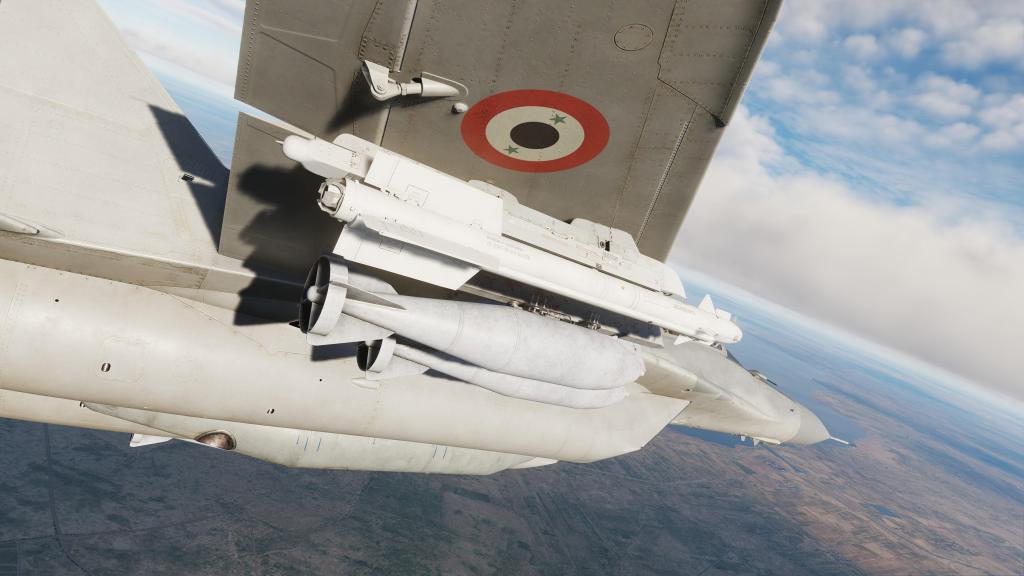
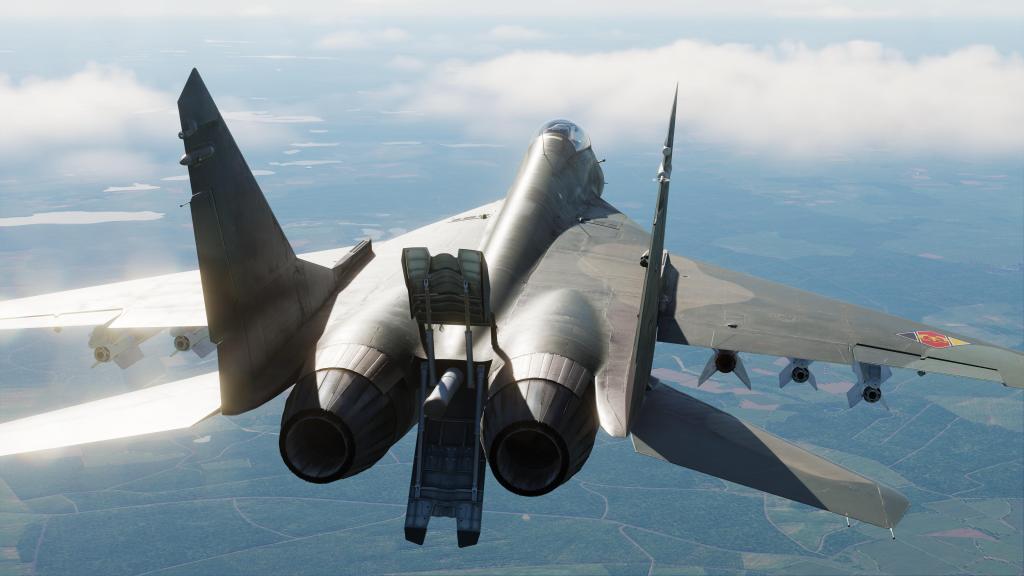
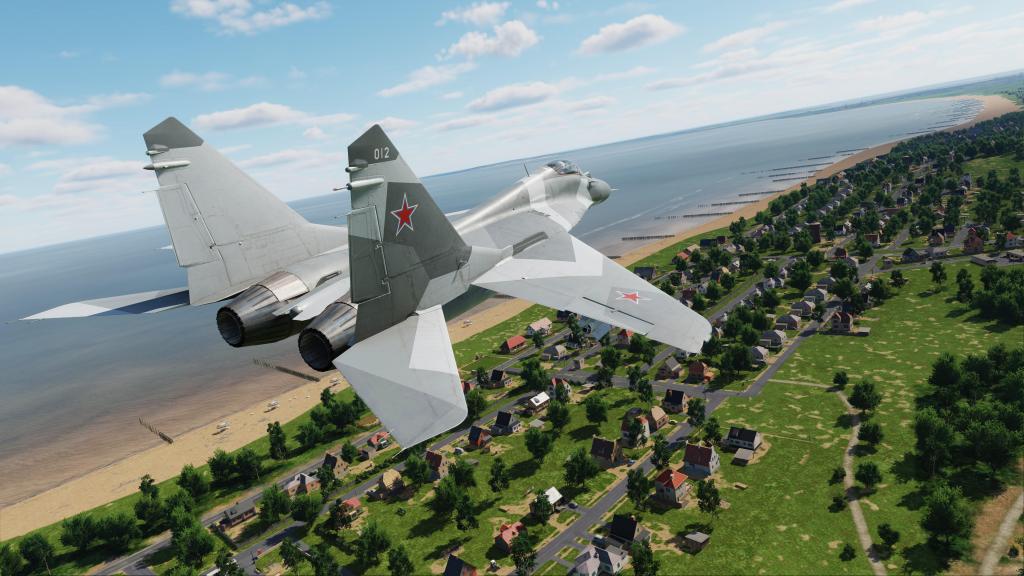
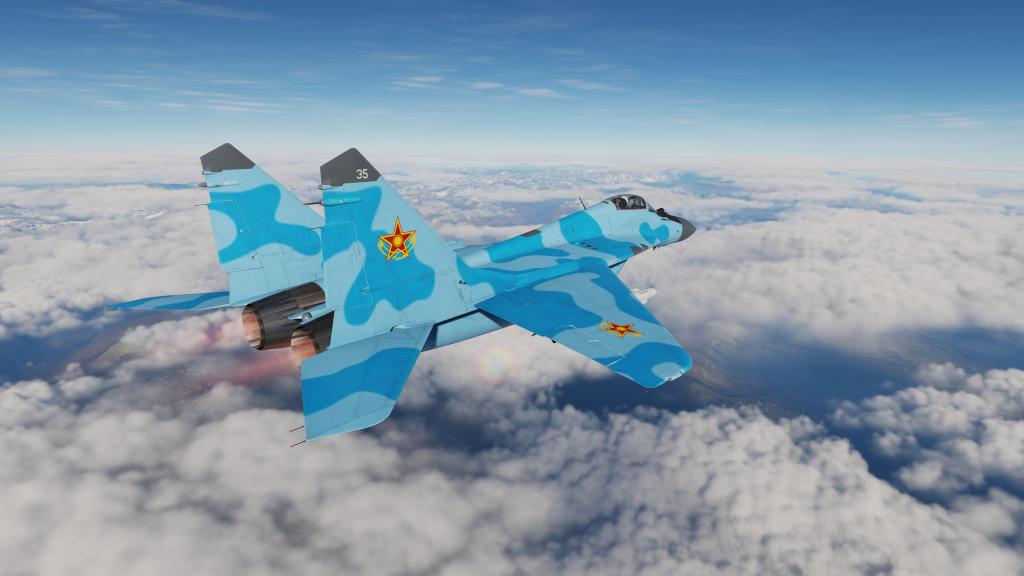
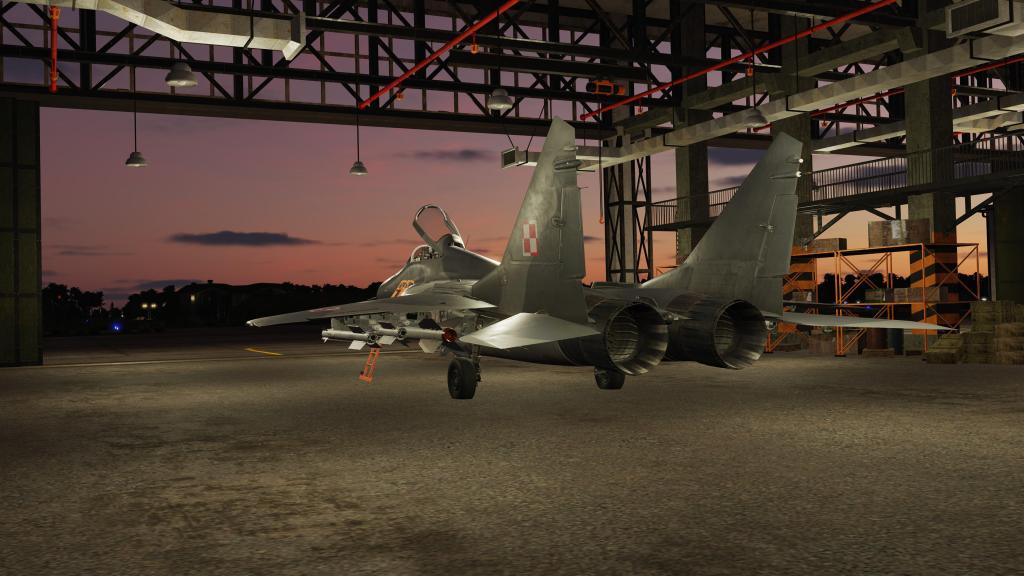
Like with quite a few early access releases, there is a list of liveries but I know MiG-29 fans are hoping for more. We do have a few Russian schemes, East Germany, Poland, Azerbaijan, and Syria but we are missing some common users like Serbia, Ukraine, and reunified Germany. A paint kit is reportedly on the way by October and more liveries are coming but livery artists are already on the job producing some schemes like these three featuring an early Polish Air Force scheme, a Ukrainian scheme and this very blue Azerbaijan scheme.

One other source of annoyance is your AI wingmates. They have their radar on constantly (unless the mission is specifically scripted), so if you’re flying with a wingman you’ll want to turn down the SPO-15 RWR otherwise it will be blaring in your headset or through your speakers for the whole flight. That’s not ideal.
These are largely expected omissions and none of them are going to stop you from flying or fighting the MiG-29 but they are worth pointing out as you contemplate a purchase.
Flying the MiG-29


Eagle Dynamics long ago did a Professional Flight Model (PFM) update to the Flaming Cliffs MiG-29. This is their top level of flight model and the core experience provided by that system has been a highlight of many DCS modules for almost a decade now. If it has PFM or PFM-like features (as many third parties have) then the flying experience is likely to be superb. DCS: MiG-29 reportedly borrows the same PFM that the Flaming Cliffs aircraft did though there do seem to be subtle differences between them.
While I’m hard pressed to find any significant differences, the MiG-29 is a bit twitchy by default and you may want to dial in some curves (I usually do +20 on pitch and roll) to get it flying a little more smoothly. But once you do, the MiG-29 becomes supremely capable as one of the hottest fighters that you can fly in this sim. It’s a rocketship with rapid acceleration, a high top speed, and incredible agility all in one package and it is oh-so-fun to fly!
The Fulcrum was designed to be a rapid reaction interceptor fighter and its quite good at this job. From the moment you kick in the afterburners on the runway you know that things are going to happen and happen quickly. A lifting body airframe design and the twin RD-33 engines provides one heck of a kick and a ton of lift to be able to climb skyward.
I haven’t yet mentioned the fuel capacity of the MiG-29 which is the type’s real Achilles heel. At full afterburner, the endurance of the aircraft can be measured in just minutes and you can watch the fuel gauge slide down the display rapidly when in this mode. That limits the aircraft’s abilities kinematically as it can certainly perform or outperform rivals but only in very short bursts. A centerline fuel tank provides extra endurance but its still limited. Two additional wing mounted tanks provide longer range, cross country, capabilities but at the expense of the same pylons used by the R-27s meaning that combat capability is supremely limited while fitted.

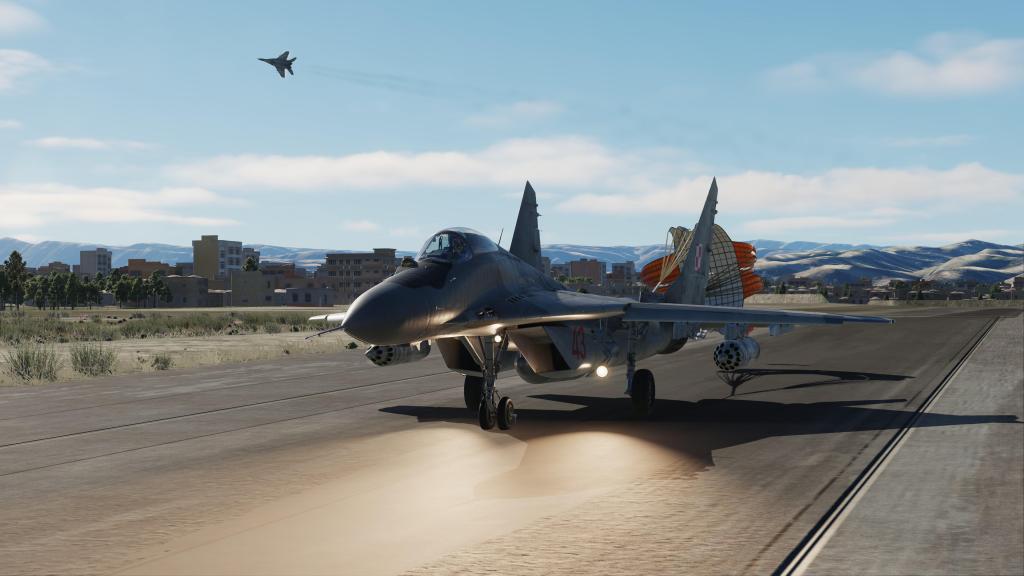
I generally find the Fulcrum easy to taxi, easy to takeoff, relatively easy to trim and get into a good cruise at altitude. It’s also very well behaved in a stall with the aircraft typically just flopping over, losing a bit of altitude, and then continuing on. Once recovery has happened, you have enough engine power to do just about anything.
The landing is perhaps the hardest part about flying this aircraft though its nothing like the adventures you go on with the MiG-21. With the Fulcrum, you’re rewarded with a good stabilized approach and a gentle flare before touchdown. Bouncing on the forward gear usually leads to an unstable roll and disaster but if you can keep the pressure more on the back wheels it tends to be quite well behaved. A drag chute manages deceleration well.
Fighting with the Fulcrum
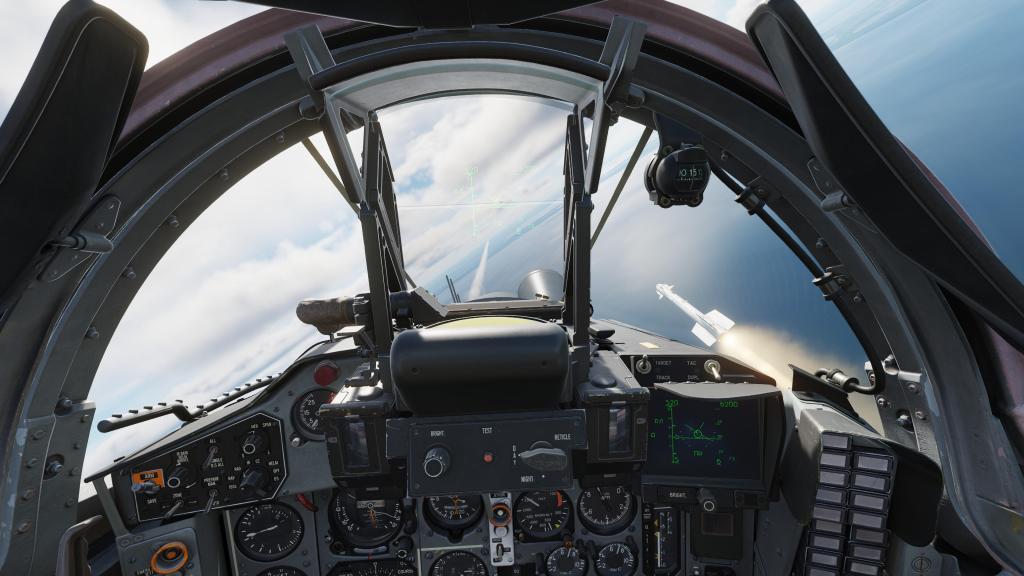


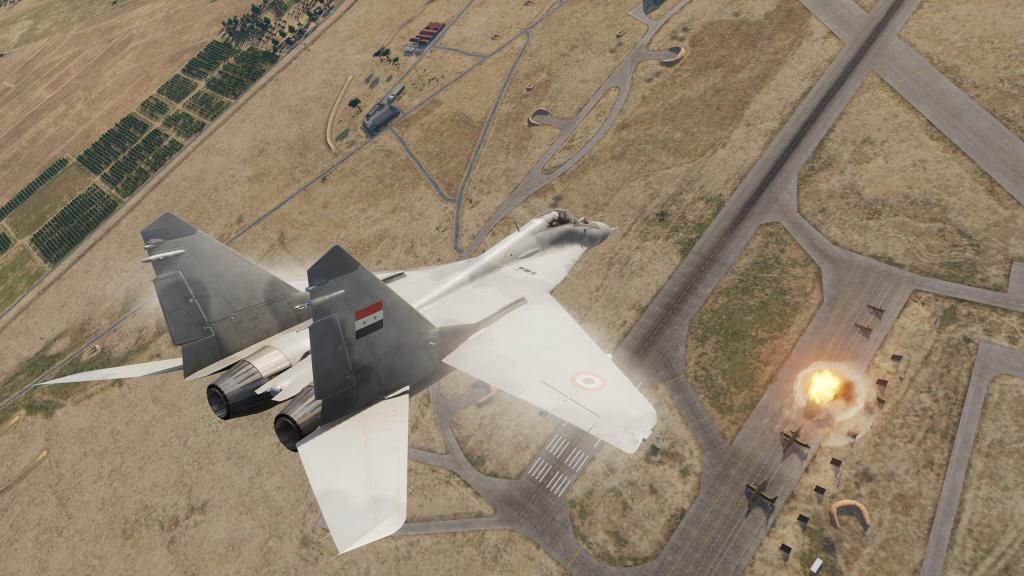

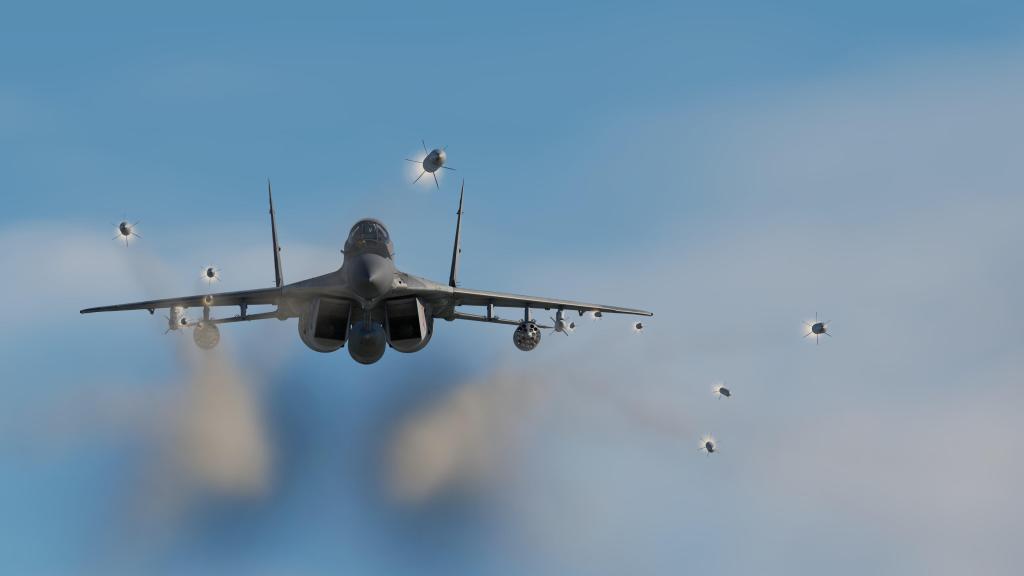
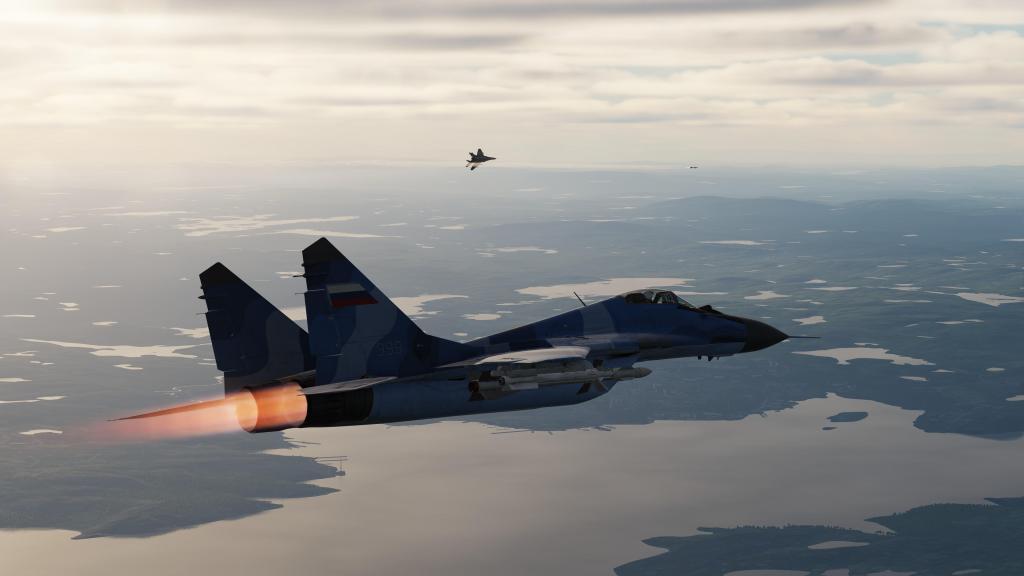


The 29 is sharp and nimble with the ability to do rapid rolls, turns, and with agility that is closely followed by only a few other aircraft. In close in fights, the Fulcrum is impressive in its ability to point its nose and position itself for a kill. I’m sure there will be detailed efforts by the community to figure out where this version of the MiG-29 fits in but I can say confidently that it has the kind of agility that you see on the F-16 and F/A-18.
In air to air, the MiG-29 is an incredible dogfighter and a capable BVR fighter too although the maximum capacity of medium range, semi-active or IR guided R-27 missiles, is just two. The aircraft also has a helmet mounted sight, one of the first deployed on a combat aircraft, and that gives the pilot the ability to select and queue up an R-73 short range missile for an off aspect shot. Its not quite as extreme as the JHMCS and AIM-9X 90 degree off bore-sight capability and indeed the R-73 in this mix is listed as having just 40 degrees off bore. Its still an impressive capability.
The situation becomes a bit more precarious when you get into the beyond visual range duel. This is more of a sensors game and the MiG-29 much more limited here in being able to build up a good picture of what is ahead. The radar is good at picking out targets but not great and the previously mentioned RWR is interfered with when the radar is on so missile duels are an even more dangerous affair when you don’t know if the enemy has lobbed a missile at you. Even with it off, some missiles like the AMRAAM are not picked up by the SPO-15. Assume the enemy has already fired at you if in range! The IRST is a much closer in sensor with ability to detect out maybe 10-12 nautical miles. While that sounds like a disadvantage, it is quite good in setting up ambushes with what is strictly a passive sensor. Combine that with the IR guided R-27T or R-27ET and you have some sneaky combat potential.
The MiG-29 was also designed to operate alongside a GCI (ground control intercept) with theatre level sensor information. When this is available, the MiG-29 does well, but absent that kind of information the 29 struggles with situational awareness relative its closest peers. Some additional GCI related systems are on the way so we’ll have to see how that calculation changes over time.
Relative to some of the other fourth gen jets in the sim, the MiG-29 represents a fourth gen airframe and a mix of third and fourth gen avionics. There’s no datalink, no multi-function displays, and no active radar guided missiles. It’s great at ambushes and rapid reaction interceptions but it’ll struggle to defeat an AMRAAM equipped Hornet, Viper or Eagle in a head-on fight. Mix that fight up a bit or bring it in a little closer, however, and the Fulcrum has a chance to shine.
Ground attack capabilities are present with a mix of bombs and rockets. Some of the bombs are munition dispensers with anti-armor bomblets while others are standard general purpose bombs in 250kg and 500kg variety. The jet has a pretty good CCIP-style system, aided by laser range finder, that does allow for accurate bomb and rocket attacks drops. There’s also a bomb-toss function adds extra flexibility in contested environments though I have yet to try this.
If all of the fancy stuff fails, you’ve still got a 30mm GSh-30-1 autocannon that provides a ton of hitting power versus aerial targets or against the ground in specific air-to-ground modes too.
Versus Flaming Cliffs 3’s MiG-29
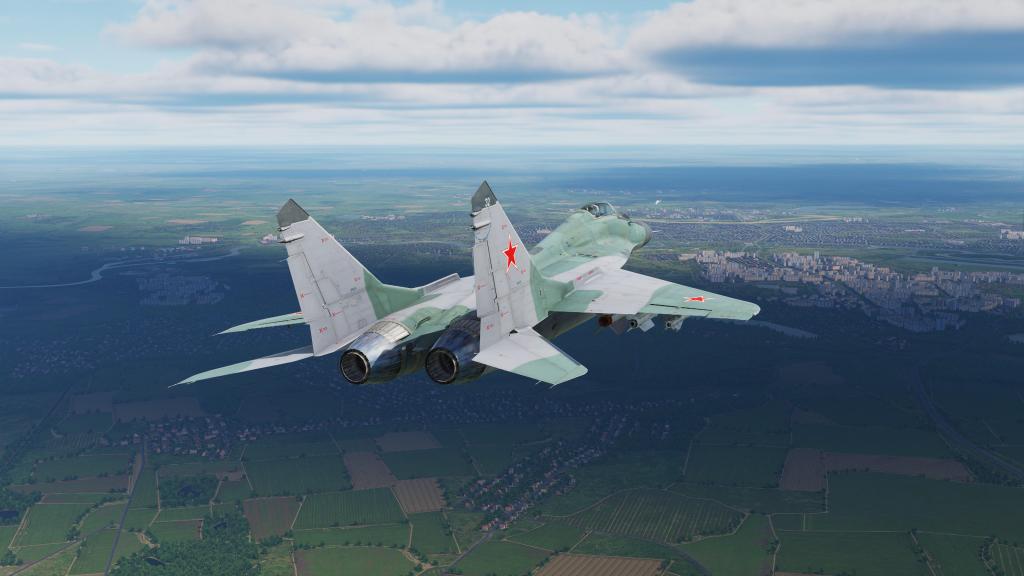

One of the things that I’ve seen come up in community conversations is the question of “why should I buy this one when I already have the Flaming Cliffs version?” Let’s tackle that question!
I’ve already mentioned some of the practical layers of this such as the ability to adjust the radar and IRST systems or to make more fulsome use of the navigation suite. But the more complete reason for me, at the very least, is because I want to know how the MiG-29 works and that means having an INS system that isn’t perfect or learning what a start-up and shut-down procedure looks like. If you have a flameout, the restart procedure is there for you to perform. That’s the benefit of having systems that are more deeply simulated as it gives you more of the experience of operating the airplane.
These kinds of details take time to research and program but Eagle Dynamics various teams have a lot of experience doing that sort of work. In that sense, MiG-29 breaks no new ground, but it does give us an airframe that many of us wanted to see done with more detail.
There’s also absolutely nothing wrong with the Flaming Cliffs version either. Rather than replacing it, the full fidelity version provides the kind of depth that many DCS pilots are after. But not everyone wants that and if your interested in just the basics, the Flaming Cliffs version has a great visual model, a great flight model, and you can key bind it with just a handful of controls. If that’s all you want, you can have a fantastic DCS experience for cheap and with a much more minimal learning curve. On the other hand, if you want more from the experience the DCS: MiG-29 is the direction you should be considering.
Learning opportunities
There are some great opportunities to learn how to fly the MiG-29. Right now its Matt Wagner, from Eagle Dynamics, who probably has the most comprehensive collection but I’m sure that there will be more coming from community members (or may already be out there by the time you read this.
Matt Wagner’s videos include a cold and dark, navigation, aerial and ground attack, and some other information mixed in throughout. I highly recommend using those as a training guide.
I also want to draw attention to the Early Access DCS: MiG-29A Fulcrum PDF manual. It’s sometimes hard to search for as the Flaming Cliffs version comes up but it is located in PDF format here.
Final thoughts
DCS early access modules have been approached with quite a bit of trepidation in recent years. We’ve had some good releases and we’ve had some very barebone releases too. So where on the scale does the DCS: MiG-29 fall?
Generally speaking I’m pleased with what is on offer. A hotfix has just arrived and it has solved some immediate problems. With those issues out of the way we now have a MiG-29 flies great, fights well, and has all of its weapons and nearly all of its combat capabilities here on day one. You’ll be able to take it into a competitive multiplayer server or into a detailed single player scenario and feel like you have a reasonably reliable airplane on offer though I think the radar and IFF reliability are still something that might give pause – realistic issue or a more subtle bug I’m not sure.
The features that MiG-29 does lack are some more interesting capabilities. For example, I’m very interested to see how the GCI functionality is added into the jet and I have no real understanding of what this will be like. Some have alluded to a similar functionality in the Mirage 2000C so we’ll have to see how that goes.
I am pleased to see that the jet comes with virtually its entire armament package. You won’t be stuck waiting for the core weapon types. No additional types are listed and I think we have the entire compliment from the Flaming Cliffs version so I think we’ve got what we’re going to get here. Generally speaking, that’s good!
Of course, like many DCS modules, MiG-29s biggest issues are content. It has a few options and the community will no doubt step in, but when it comes to day one content, its a very thin. That will change with time and scenario makers will likely also find the type’s history and varied operators as fertile ground to make scenarios with.
If you’re an enthusiast of the MiG-29 or just really excited to see a high fidelity Russian fighter added to the mix, I think you’ll probably find the DCS: MiG-29A Fulcrum a good buy. It has most of its features already in place, it has a few bugs but nothing outrageous, and its already a shoe-in for a variety of scenarios. If you’re already satisfied by the Flaming Cliffs version or its not your thing, that’s alright too. Early access does mean waiting for a few cool features but really its the content that we need to see expanded out and I think that’ll happen quickly thanks to the community more than anything else.
If its your thing, the DCS: MiG-29A Fulcrum can be purchased on Steam or the DCS e-Shop for $63.99 USD with a 20% off early access discount. The aircraft’s full price of $79.99 USD will hit only when its out of early access.
Screenshots













 Stormbirds
Leave a reply to Wildvalach Cancel reply